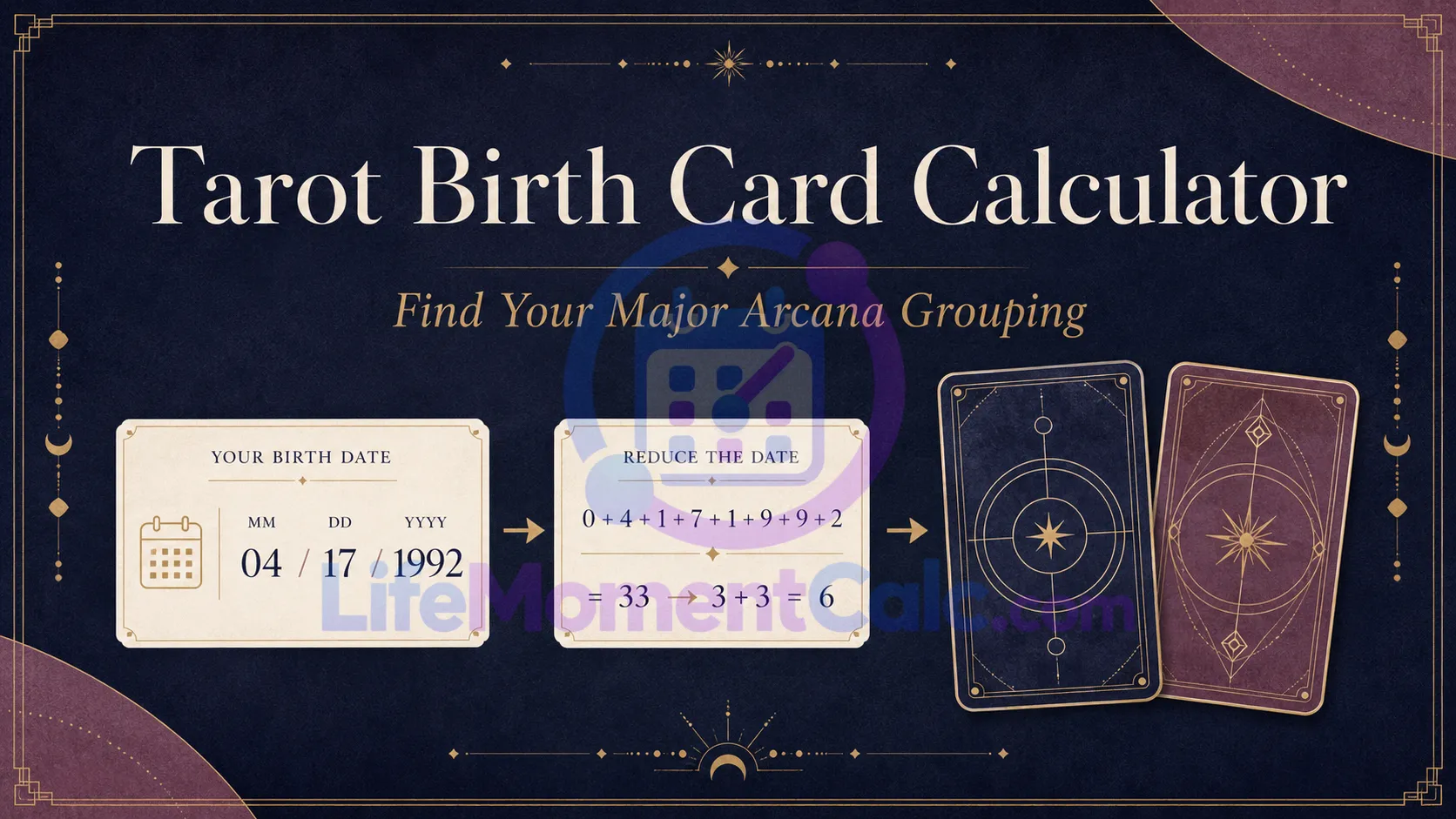
A tarot birth card is a modern interpretive practice that connects date based numerology with the Major Arcana. The Tarot Birth Card Calculator applies one transparent component sum method and shows the calculation rather than presenting a card without explanation.
Enter a birth date to receive a main card and, when applicable, a companion card or the special 19/10/1 grouping. Each result includes an original reflection theme intended for journaling and personal exploration, not prediction.
Calculate a transparent Major Arcana birth-card pairing, show the arithmetic, and explore original reflection prompts. Reflective tarot practice—not a factual personality test or prediction. The component-sum method adds birth month + birth day + the first two year digits + the final two year digits, then repeatedly adds digits until the result is 22 or lower. The reduced main number gives a Major Arcana card; a second reduction gives the companion card. Result 19 uses the familiar 19/10/1 group. Tarot birth-card systems are modern interpretive practices and different readers calculate them differently. The chosen Fool policy and every arithmetic step are visible. Card keywords are concise reflection prompts, not predictions.Tarot Birth Card Calculator
Tarot birth-card reflection
Method used
Traditions vary
Begin with Your Birth Date
Enter a valid past date and choose how the calculator should handle a reduced result of 22. One option treats 22 as The Fool. The other reduces 22 to 4, corresponding to The Emperor in the selected numbering system.
Keep Show calculation steps enabled to see the components, original sum, and reduction path. Select Find tarot birth cards to generate the grouping.
The result names the cards, displays their numbers, and presents a concise theme for each. The same date and Fool policy always return the same grouping.
Formula Used to Calculate Tarot Birth Cards
The year is separated into its first two and final two digits. The calculator then adds:
Birth month + birth day + century portion + year within century
For 14 September 1992, the components are:
9 + 14 + 19 + 92 = 134
When the sum is greater than 22, its digits are added:
1 + 3 + 4 = 8
The main result is therefore card 8 under the plugin’s numbering.
If the main number is between 10 and 18 or between 20 and 22, the digits are added again to create a companion card. A main result of 14, for example, creates the grouping 14 and 5.
Result 19 receives special treatment:
19 → 10 → 1
This produces the three card grouping of The Sun, Wheel of Fortune, and The Magician.
If the main result is 22, the selected Fool policy determines whether the tool keeps card 22 or changes it to card 4. Duplicate or invalid card numbers are removed.
What Main and Companion Cards Offer
The main card provides the broadest reflection theme in this system. A companion number highlights a related or more concentrated theme created through digit reduction.
These cards are not competing answers. They can be read together by asking how their qualities support, challenge, or refine each other. Someone receiving Temperance and The Hierophant, for example, might reflect on the relationship between balance and inherited structures without treating either card as a fixed personality label.
The brief prompts are intentionally open. They do not reproduce commercial deck guidebooks or claim to reveal hidden facts.
Why Tarot Birth Card Results Can Differ Elsewhere
Tarot numerology has multiple conventions. Calculators may add individual date digits, combine date components differently, number The Fool as 0 or 22, or use different card pair rules.
Differences do not necessarily indicate an arithmetic error. They often mean that two sources follow different traditions. This page makes its component sum, reduction, and Fool handling visible so its result can be repeated.
For a random card exercise rather than a date based grouping, use the Beginner Tarot Reading Tool.
A Practical Reflection Exercise
Write the names of your cards at the top of a page. Under the main card, note where its constructive theme appears in your current life. Under the companion card, identify one situation where that quality could be developed more intentionally.
Next, consider the less comfortable side of each theme. Structure can become rigidity; openness can become carelessness; reflection can become isolation. Balanced interpretation makes the exercise more useful than choosing only flattering meanings.
Finish by recording one practical action. The value of the exercise comes from thoughtful engagement, not from assuming that the card controls events.
Historical and Responsible Context
Tarot began in Europe as a card game. Its association with occult interpretation and divination developed much later. Birth card calculation is a modern symbolic practice rather than an ancient method of psychological classification.
The arithmetic is objective once a convention is selected, but the interpretation is subjective. A tarot birth card cannot diagnose mental health, establish ability, determine compatibility, or predict personal outcomes.
Do not use the result as a substitute for medical, legal, financial, or safety advice.
Frequently Asked Questions
Is The Fool card 0 or 22?
Both conventions appear in modern tarot practice. This calculator allows you to choose how a reduced value of 22 should be handled.
Can the result contain only one card?
Yes. A final number below 10 does not require another reduction, so the grouping contains one card.
Does a tarot birth card change every year?
No. This calculator derives the grouping from the birth date, so it remains constant under the same method.
Is the card a prediction of the future?
No. The result is designed as a repeatable reflection prompt, not a forecast or factual personality assessment.