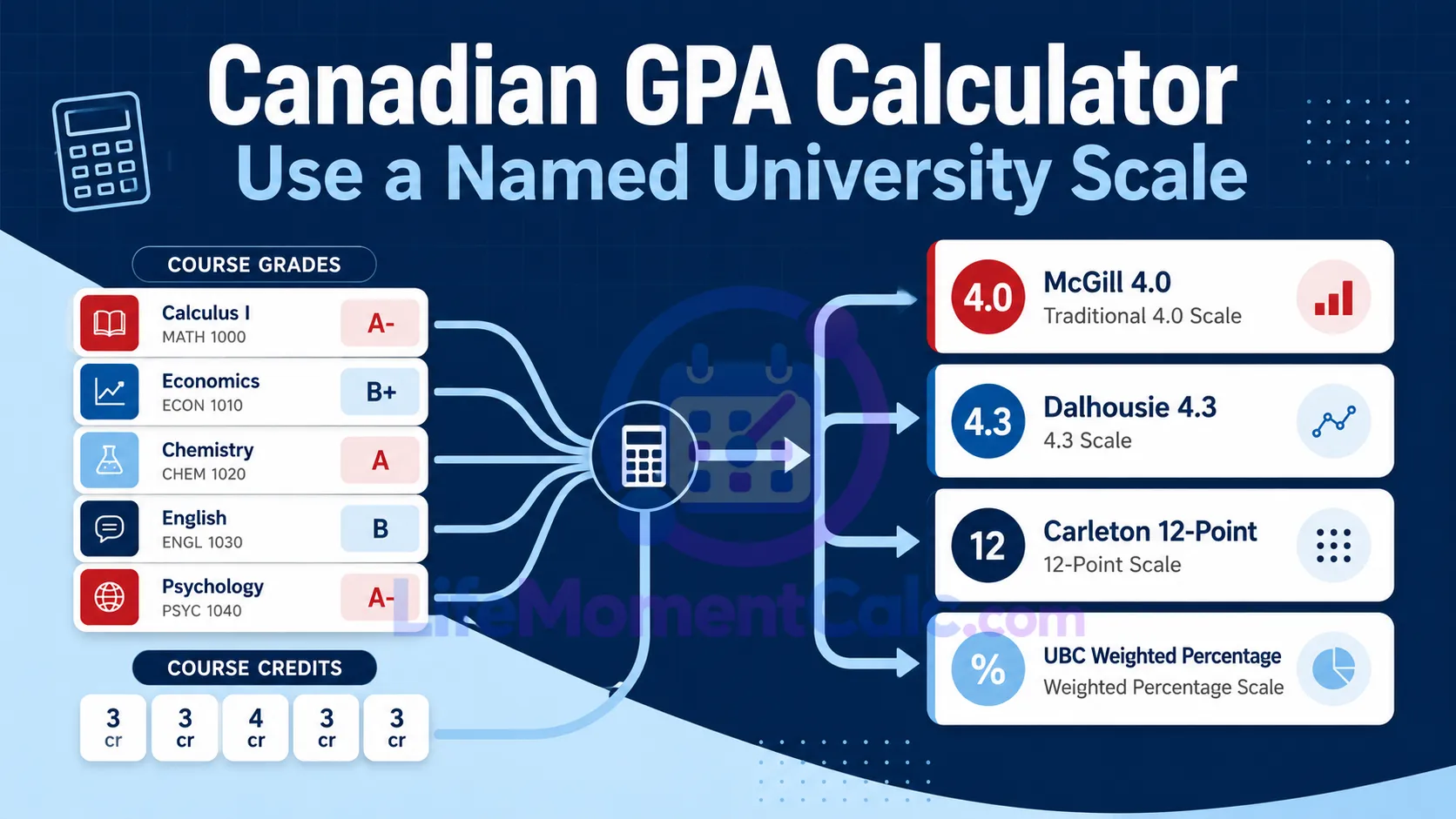
Canada does not use one national or provincial GPA scale. The Canadian GPA Calculator therefore requires a named institutional preset before processing course grades and credits.
It supports McGill’s undergraduate 4.0 scale, Dalhousie’s 4.3 scale, Carleton’s 12-point scale, and a UBC weighted-percentage result. UBC is not presented as a native GPA because its standard academic reporting is percentage-based.
Calculate a credit-weighted result using a named university scale instead of a misleading province-wide conversion. Canadian universities do not share one national or provincial GPA conversion. This tool uses named official scale presets for McGill, Dalhousie, and Carleton. UBC normally records percentage grades, so its preset calculates a weighted percentage rather than inventing a GPA. For GPA scales, each grade point is multiplied by course credit, those products are summed, and the result is divided by total included credits. Institutional rules for repeats, exclusions, pass/fail courses, and program standing can differ; your official transcript remains authoritative.Canadian GPA Calculator
Weighted academic result
Institution—not province—determines the scale
Formula
Choose the Institution Before Adding Courses
Select the scale that applies to the academic record. Add each included course, grade, and credit value.
Grades may be entered as supported letter grades or numeric percentages. When a percentage is supplied for a GPA scale, the tool maps it to the published letter-grade threshold and associated point value.
For UBC, enter percentages from 0 to 100. The result remains a weighted percentage instead of being converted into an invented four-point GPA.
Course names are optional labels, but every included course needs a valid grade and positive credit value.
Formula Used by the Canadian GPA Calculator
For a GPA-based preset, each course’s grade is mapped to its institutional grade-point value.
Course quality points = Grade points × Course credits
All included course products are added:
Total quality points = Σ(Grade points × Credits)
The weighted result is:
GPA = Total quality points ÷ Total included credits
Suppose three courses have these point and credit values:
- 4.0 points × 3 credits = 12.0
- 3.0 points × 3 credits = 9.0
- 3.7 points × 6 credits = 22.2
GPA = (12.0 + 9.0 + 22.2) ÷ (3 + 3 + 6)
GPA = 43.2 ÷ 12 = 3.60
For UBC:
Weighted percentage = Σ(Course percentage × Credits) ÷ Σ(Credits)
The arithmetic structure is the same, but the underlying values remain percentages.
How the Presets Differ
McGill
The undergraduate preset uses a maximum of 4.0. A and A+ both correspond to 4.0 in the implemented table, while lower letter grades map to their published points.
Dalhousie
Dalhousie uses a 4.3 maximum, with A+ mapped to 4.3. This means the same set of letter grades may produce a different numeric GPA from a 4.0 system.
Carleton
Carleton uses a 12-point scale, with A+ equal to 12, A equal to 11, and subsequent letter grades descending through the published point values.
UBC
The UBC preset calculates a weighted percentage. A receiving institution may apply its own equivalency procedure when evaluating UBC grades. This calculator does not choose that external conversion.
Understanding the Course Table
The result includes a row for each course, showing the grade used, credits, and mapped points. The headline reports estimated GPA or weighted percentage, depending on the selected preset.
Supporting details identify the institutional scale, total included credits, and number of courses.
Review the per-course mapping before relying on the total. A mistyped letter grade or credit value can materially change a weighted result.
Why “Canadian GPA” Is Not One Number
Universities establish their own grading systems. Even institutions using the same maximum may publish different percentage thresholds, grade exclusions, repeat-course rules, or academic-standing procedures.
A province does not automatically determine the scale. The school, faculty, program, academic level, and policy year may all matter.
For grade-point-to-percentage conversion under a separately prescribed formula, use the DGPA to Percentage Calculator.
Rules the Estimate Cannot Apply Automatically
Official calculations may treat these items differently:
- Repeated courses
- Failed or excluded attempts
- Pass/fail and credit/no-credit courses
- Transfer credits
- Withdrawals
- Courses outside a program
- Different academic levels
- Rounding at intermediate or final stages
The calculator includes the courses entered and applies the selected mapping. It does not have access to an institutional transcript or program audit.
Frequently Asked Questions
Is this an official GPA?
No. It is an estimate. The official academic record remains authoritative.
Can courses from different universities be combined?
Not reliably under one preset. Different scales may require institutional evaluation.
Why does UBC return a percentage?
The tool preserves UBC’s percentage-based reporting instead of inventing a native GPA.
Do higher-credit courses affect the result more?
Yes. Each course value is multiplied by its credits before the total is divided by all included credits.