A Japanese Age Calculator can answer two related questions: how old someone is under the modern completed-birthday system and how that age compares with traditional kazoedoshi.
The tool also formats the birth and reference dates in the Japanese era calendar. This is important because an era transition occurs on a specific date, not simply at the beginning of a Gregorian year.
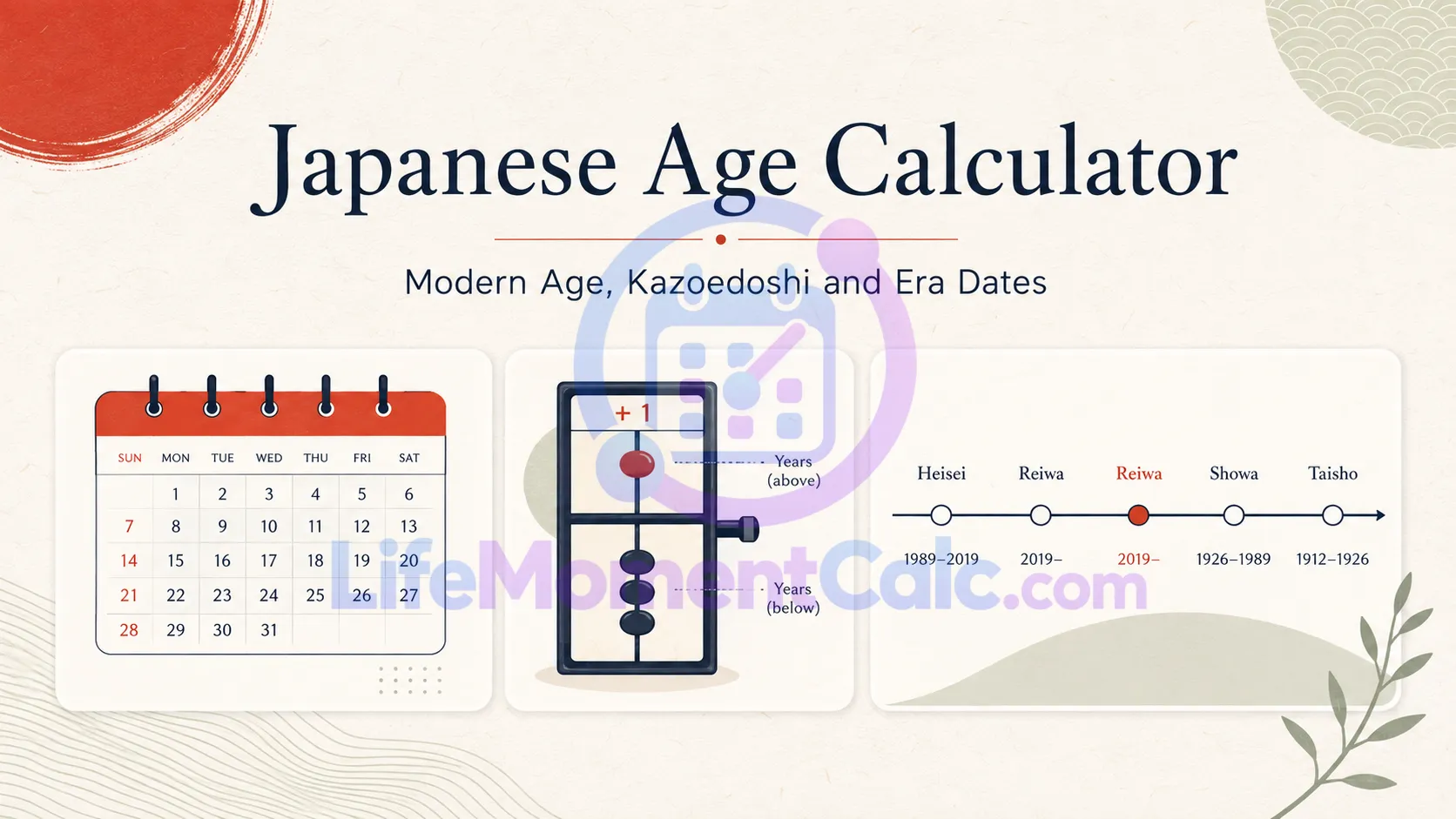
Calculate modern age, traditional kazoedoshi, Japanese era dates, days lived, and the next birthday. Modern Japanese age (man-nenrei) counts completed birthdays and is the ordinary official measure. Traditional kazoedoshi counts one at birth and adds one each New Year’s Day; it is included only as cultural and ceremonial context. The tool also formats the birth and reference dates in the Japanese era calendar, including day-specific transitions such as Heisei beginning January 8, 1989 and Reiwa beginning May 1, 2019. The claim that Japan first switched to Western age in 2023 is incorrect and is not used here.Japanese Age Calculator
Japanese age comparison
Modern and traditional systems
Japanese era dates
Modern Japanese Age and Cultural Age
Modern Japanese age, often described as man-nenrei, counts completed birthdays. A newborn is zero, and age increases on each birthday.
Traditional kazoedoshi counts one at birth and adds one at New Year. It is included as historical and ceremonial context rather than the ordinary official age.
The calculator keeps these values separate so that cultural language does not replace the modern chronological result.
Formulas Used by the Japanese Age Calculator
Modern age is calculated with calendar-aware birthday arithmetic:
Modern age = reference year − birth year − 1 when the birthday has not yet occurred
Once the birthday has occurred:
Modern age = reference year − birth year
Traditional kazoedoshi is:
Kazoedoshi = reference year − birth year + 1
The tool also calculates completed months and days after the most recent birthday, total civil days lived, and days until the next birthday.
Japanese Era Dates Are Day-Specific
Japanese era formatting identifies the era and year that apply to the exact civil date.
For example, Shōwa continued through January 7, 1989, and Heisei began on January 8. Heisei continued through April 30, 2019, while Reiwa began on May 1.
A converter that uses only the Gregorian year could label transition-year dates incorrectly. This tool passes the full date through the browser’s Japanese calendar implementation.
What Appears After Calculation
Enter a birth date and calculation date between 1900 and 2100. The result presents:
- Modern Japanese age
- Traditional kazoedoshi
- Birth date in the Japanese era calendar
- Reference date in the Japanese era calendar
- Exact age in years, months, and days
- Next birthday and days remaining
- Total days lived
Together, these details provide chronological, cultural, and calendar-era context without combining them into one ambiguous value.
When This Comparison Is Useful
The calculator can help with family history, Japanese-language learning, era-date interpretation, travel preparation, and reading documents that use Japanese era years.
It is also useful when someone encounters an age stated under a traditional method and wants to understand why it differs from completed age.
For direct comparison with another East Asian age tradition, see the Korean Age Calculator.
Leap Dates and Calendar Behavior
Gregorian chronological age requires valid month-and-day arithmetic. The calculator treats date-only inputs as civil dates, avoiding daylight-saving shifts that can distort a day count.
February 29 birthdays use February 28 for the next-birthday and age comparison in non-leap years within this tool. This is a calculation convention and should not be read as a universal legal rule.
Japanese era formatting depends on the standards-based calendar data available in your browser. Unsupported calendar data produces an error rather than a fabricated era label.
Modern Age Remains the Primary Answer
Kazoedoshi can be meaningful in traditional ceremonies, historical descriptions, or discussions of older customs. It is not presented as the ordinary modern legal age.
Likewise, a Japanese era date is another way of expressing a calendar date. It does not change the elapsed age between the birth and reference dates.
The Japanese Age Calculator provides a reliable primary age while preserving the additional context people are actually searching for. Each value is labeled, the equations are visible, and day-specific era transitions are respected.