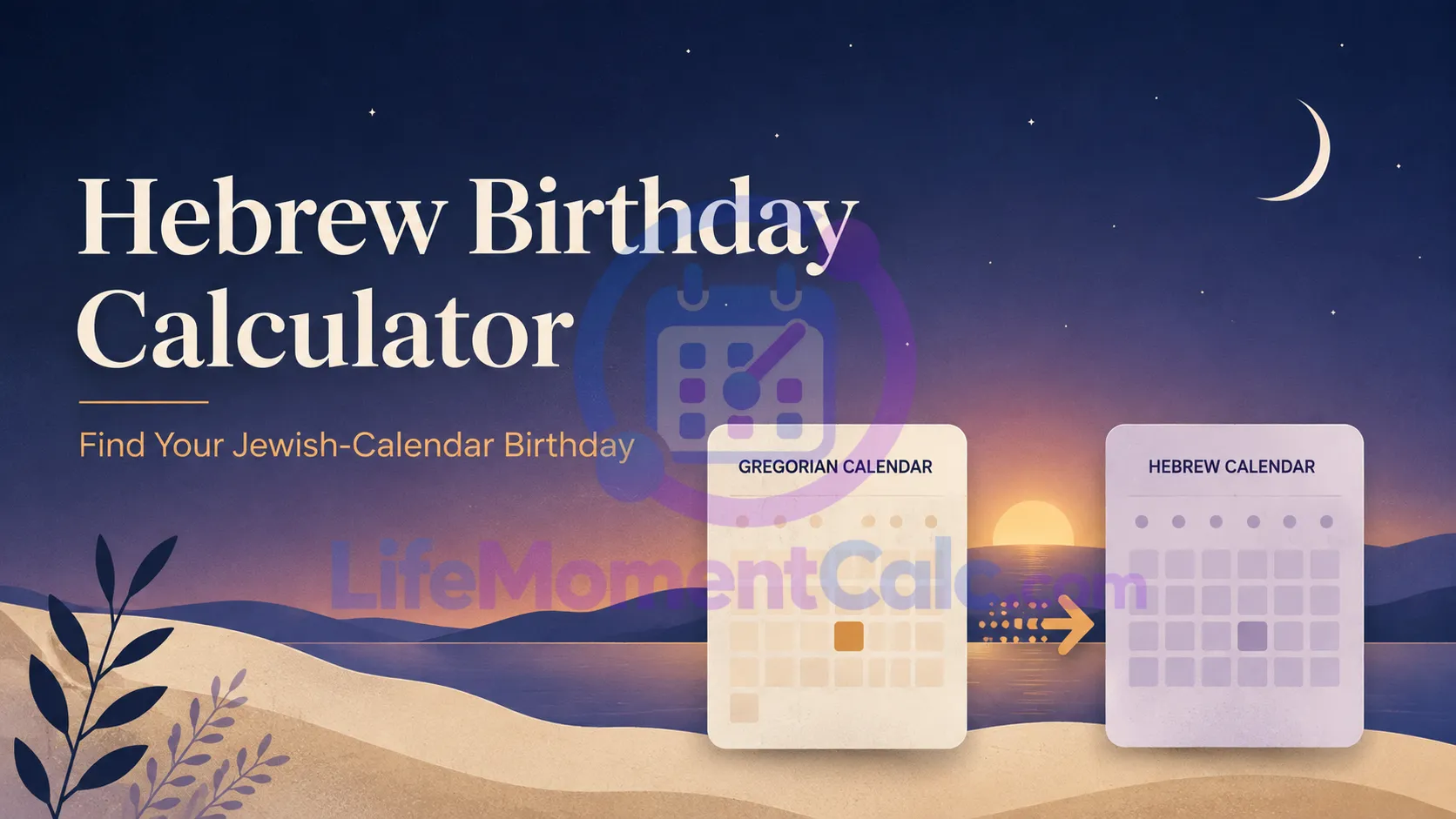
A Hebrew Birthday Calculator needs more information than a Gregorian date alone. Hebrew calendar days begin at sunset, so a birth recorded on one civil date can correspond to either of two Hebrew dates depending on the time and location.
The calendar also contains leap years with Adar I and Adar II, while certain months do not always contain the same number of days. This calculator makes those decisions visible and can show both possibilities when sunset status is unknown.
Find a Hebrew birth date and upcoming Jewish-calendar birthday while accounting for the sunset boundary and leap months. A Hebrew calendar day begins at sunset, so the civil date alone may be insufficient. “After sunset” advances the date by one civil day before conversion. If sunset status is unknown, the tool shows both possible Hebrew birth dates without claiming false precision. Upcoming dates use a documented Ashkenazic-style calendrical convention for Adar and variable-length months. Religious practice can differ, especially for Adar I/II and dates that do not occur every year; consult a qualified local authority when observance is important.Hebrew Birthday Calculator
Hebrew birthday
Sunset boundary
Anniversary convention
The Civil Date May Not Tell the Whole Story
Select Before sunset when the birth occurred before the local sunset that ended the Hebrew date. Select After sunset when the birth occurred afterward; the calculator advances the civil date by one day before conversion.
If the time or sunset relationship is unknown, choose the uncertainty option. The tool will calculate both possible Hebrew birth dates and their upcoming Gregorian anniversaries.
This is more responsible than selecting one date without evidence.
Formula and Anniversary Method Used by the Calculator
The sunset adjustment is:
Adjusted civil birth date = entered date + 1 day when birth was after sunset
The adjusted date is converted into Hebrew year, month, and day components. Completed Hebrew years are based on the difference between the reference Hebrew year and birth Hebrew year, reduced by one when the current year’s anniversary has not yet occurred.
Birthday matching follows these implemented rules:
- A birth in ordinary-year Adar or leap-year Adar II maps to the final Adar month of the target year.
- A birth in Adar I maps to Adar I in another leap year and Adar in an ordinary year.
- If a birthday occurred on day 30 of a month that has only 29 days in the target year, the anniversary moves to day 1 of the following month.
The calculator searches forward for the first date satisfying those conditions.
Understanding Adar in Leap and Ordinary Years
A Hebrew leap year contains an additional month. This creates questions that do not arise in the Gregorian calendar, particularly for births in Adar I or Adar II.
The tool uses a documented Ashkenazic-style calendrical convention. It does not claim that every community follows the same religious practice.
When observance matters, the displayed result should be discussed with a qualified local rabbi or relevant community authority.
What the Result Contains
For a known sunset status, the calculator displays:
- Hebrew birth date
- Completed Hebrew years
- Next Gregorian date of the Hebrew birthday
- Hebrew anniversary date
- Number of days until the birthday
When sunset status is unknown, an additional table compares the before-sunset and after-sunset possibilities. The two profiles may produce different birth dates and upcoming anniversaries.
The calculation date can be changed from today to another civil date, making the tool useful for historical review or future planning.
Dates That Do Not Recur Identically
Some Hebrew months can contain 29 or 30 days depending on the year. A birthday on day 30 therefore needs a defined anniversary rule when that day is absent.
The calculator checks whether day 30 exists. If it does not, it identifies day 1 of the following month rather than allowing an uncontrolled date rollover.
This rule is part of the tool’s stated convention. It should remain visible whenever the output is used for religious planning.
Appropriate Uses and Boundaries
Use the Hebrew Birthday Calculator to explore a Jewish calendar birth date, prepare a family calendar, estimate an upcoming birthday, or understand how a sunset boundary changes the result.
It is not a substitute for determining an exact historical sunset without location and time information. It also cannot decide halachic practice for every community.
For comparison, the Hijri Age Calculator also works with a non-Gregorian calendar but requires a selected calculated standard rather than an Adar anniversary convention.
Why Transparent Uncertainty Is Valuable
Many date tools hide uncertainty by returning a single answer. This calculator does the opposite. When the birth’s relationship to sunset is unknown, it preserves both possibilities.
That approach makes the result more trustworthy. The comparison shows which fact is missing, explains why it matters, and helps determine whether a birth time, location, family record, or religious guidance is needed before choosing one date.