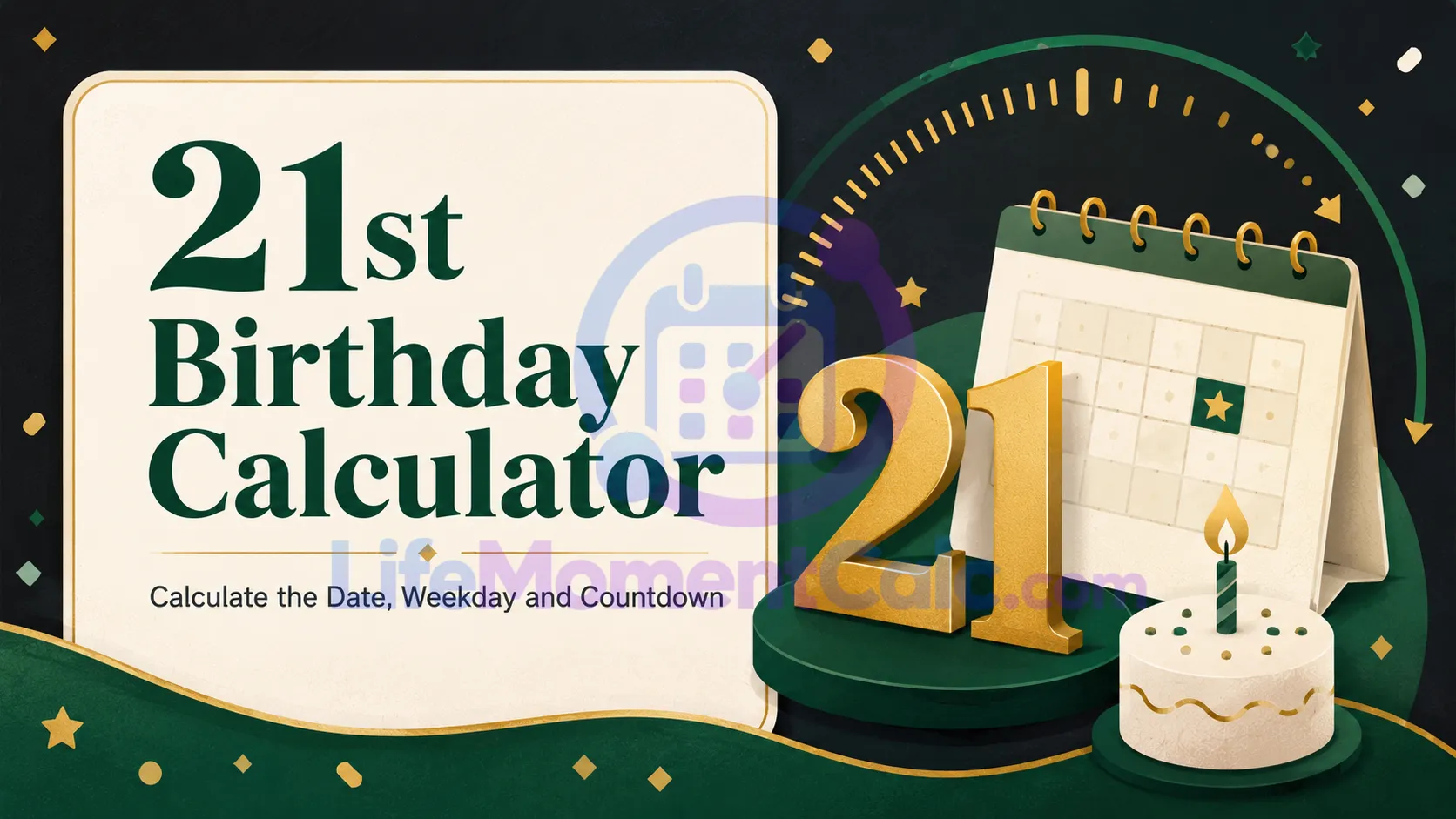
A 21st Birthday Calculator determines the date on which someone turns 21 and explains where that milestone falls relative to a selected calculation date.
The 21st birthday is culturally prominent in some places, but its legal meaning is not universal. This tool provides calendar facts—date, weekday, age, and day difference—without assuming what a person may legally do on that date.
Calculate the 21st-birthday date and a precise day-based status with transparent leap-day handling. The 21st birthday is 21 calendar years after the birth date. The result includes the weekday, completed age, total days lived on the reference date, and whether the milestone is upcoming or past. A 21st birthday is culturally prominent in some countries, but rights and restrictions depend on jurisdiction and activity. This calculator is not proof of age and does not provide legal eligibility advice.21st Birthday Calculator
Milestone details
Date calculation
Eligibility varies
Start with a Complete Birth Date
The birth year alone cannot determine whether someone is already 21 on a particular date. The month and day decide when the birthday occurs.
Enter the full date of birth, then keep today as the calculation date or choose another date. This lets you calculate a future countdown, verify age on a past date, or review how long ago the milestone occurred.
Formula Used by the 21st Birthday Calculator
The milestone calculation is:
21st birthday date = date of birth + 21 calendar years
The status is calculated with civil-day arithmetic:
Signed day difference = 21st birthday date − calculation date
The calculator also finds exact chronological age by counting completed years, then completed calendar months after the most recent birthday, followed by remaining days.
This method avoids estimating age as total days divided by 365.
Interpreting the Result Panel
The main output is the complete 21st-birthday date. Supporting result cards display:
- Milestone age
- Weekday
- Countdown or time elapsed
- Exact current chronological age
- Rule used
- Total days lived on the calculation date
The weekday is useful for event planning, while the signed day count provides a clearer timeline than a year-only answer.
Leap-Day Convention for a 21st Birthday
A February 29 birth may reach the 21-year milestone during a non-leap year. Because February 29 does not exist in that year, the calculator asks whether the birthday should be represented by February 28 or March 1.
The selected policy changes the milestone date and day difference. The result should therefore be interpreted together with that setting.
Neither option is described as universally legal. Applicable rules can differ across locations and purposes.
Planning Versus Proving Age
Use the calculator for party preparation, travel timing, personal records, reminders, and general date comparison.
Do not use a screenshot as proof of age. Businesses, government agencies, educational institutions, and regulated services normally require an accepted identity document.
Likewise, the tool does not decide alcohol access, licensing, contracts, gambling, driving, or another regulated activity. Some jurisdictions use thresholds other than 21, and exceptions can apply.
For the earlier milestone, the 18th Birthday Calculator uses the same transparent calendar method.
Why Calendar Years Are Better Than a Fixed Day Total
Twenty-one calendar years do not always contain the same number of days. Leap years add extra days, and the exact total depends on the birth date and target period.
Adding a fixed number such as 7,665 days can therefore produce the wrong civil date. The calculator adds calendar years first and calculates the elapsed-day information separately.
This keeps the milestone aligned with how birthdays are recorded.
A Precise Answer with a Clear Boundary
The 21st Birthday Calculator answers the date question completely while refusing to turn a calendar result into a legal promise.
The result provides the exact anniversary, weekday, chronological age, total days lived, and a transparent status. When official eligibility matters, that date can be used as a starting point before checking the applicable law, policy, and documentation requirements.