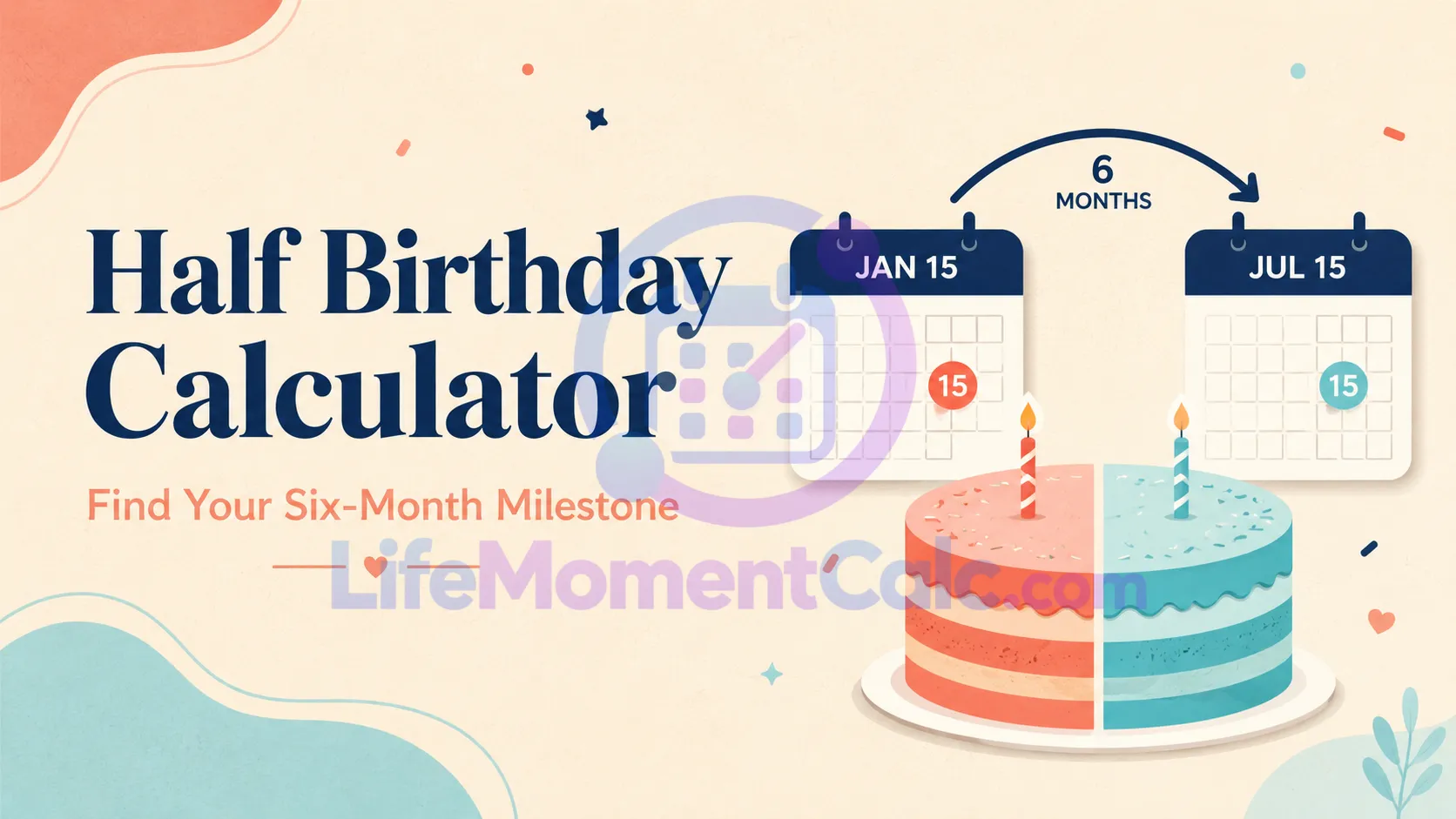
A Half Birthday Calculator answers a question that looks simple until unequal month lengths, leap years, and birthdays near the end of a month become involved. In everyday use, a half birthday normally means the date six calendar months after a birthday. Someone born on April 12, for example, has a calendar half birthday on October 12.
Not every date produces such a neat result. A person born on August 31 cannot have a half birthday on February 31, and dividing 365 days by two can produce a different date from adding six calendar months. This calculator handles those differences openly instead of hiding them behind one unexplained answer.
Find the next six-calendar-month milestone, the exact midpoint of the current birthday year, and nearby quarter dates. The primary date adds six calendar months to the relevant birthday anniversary, keeping the day where possible and otherwise using the target month’s final day. The result also shows the elapsed-time midpoint between the surrounding full birthdays; the two dates can differ by a day. A half birthday is a celebration or planning convention, not a legal change of age. If an organization uses half-year eligibility, follow its written date rule rather than assuming this calendar convention.Half Birthday Calculator
Half-birthday schedule
Two valid conventions
Informal milestone
Two Useful Interpretations of a Half Birthday
The calculator treats the six-calendar-month date as the primary result because this is the most intuitive convention for celebrations, school activities, and personal reminders. It also calculates the true elapsed-time midpoint between the previous and next full birthdays.
These two results can differ by one day. A birthday year may contain 365 or 366 days, while the six calendar months on either side can have different numbers of days. Showing both dates lets you choose the convention that matches your purpose.
If you want a fuller schedule rather than a single midpoint, the Quarter Birthday Calculator divides the birthday year into three-, six-, and nine-month milestones.
Formula Used by the Half Birthday Calculator
The primary calculation is:
Calendar half birthday = relevant birthday anniversary + 6 calendar months
The tool first identifies the birthday anniversary associated with the selected calculation date. It then moves forward six calendar months while attempting to keep the same day number.
When that day does not exist in the destination month, the calculator uses the month’s last valid date:
Adjusted day = minimum of the original day and the number of days in the target month
For example, six months after August 31 falls in February. Because February has no 31st, the result becomes February 28 in a common year or February 29 in a leap year.
The exact midpoint is calculated separately:
Midpoint instant = (previous birthday instant + next birthday instant) ÷ 2
If that midpoint lands at noon between two civil dates, the result displays both dates rather than pretending that only one date is mathematically correct.
How to Use the Calculator
Enter your complete date of birth, then choose the date on which you want the schedule calculated. The calculation date defaults to today, but you can select another date when planning ahead or reviewing a past birthday year.
For a February 29 birth, choose whether a non-leap-year birthday should be observed on February 28 or March 1. The calculator does not assume that one policy is universally correct.
After selecting Find half birthdays, the result identifies the next calendar half birthday and shows:
- The number of days until that date
- The exact elapsed-time midpoint
- The length of the current birthday year
- Whether a month-end adjustment was needed
- Nearby quarter, half, and three-quarter dates
The displayed schedule is more useful than a standalone date when planning recurring reminders or comparing different birthday-year conventions.
Why Month-End Handling Matters
Dates on the 29th, 30th, or 31st need deliberate treatment. Simply allowing a programming language to roll an invalid date into the next month could turn an intended February result into a March date without warning.
This calculator prevents that behavior. It selects the final valid day of the target month and labels the adjustment in the output. Your result therefore remains connected to the six-month calendar rule.
Leap-day birthdays receive an additional setting because their annual anniversary is itself variable. Your February 28 or March 1 selection influences which birthday year is examined and can affect the surrounding schedule.
Practical Reasons to Calculate a Half Birthday
Half birthdays are informal, but the dates can still be useful. Parents sometimes choose them for a small classroom celebration when a child’s birthday falls during a school holiday. Families may use the six-month point for photographs, memory books, or developmental records without treating it as a replacement for the actual birthday.
Adults can use a half birthday as a personal review point. It creates a milestone based on an individual birthday year rather than January-to-December resolutions. It can also help with event planning when the next full birthday is too distant for immediate preparation.
The schedule should not be used automatically for age-based eligibility. A school, employer, government agency, sports organization, or medical provider may define “six months” differently in its written rules.
Understanding the Result Responsibly
A half birthday does not increase chronological age and has no automatic legal effect. A person remains the same number of completed years old until the next full birthday.
Use the calendar date for celebrations and general planning. Use the elapsed-time midpoint when your question genuinely concerns the mathematical center of the birthday year. For formal eligibility, follow the rule published by the organization making the decision.
The strength of this Half Birthday Calculator is not merely producing a date. It shows which convention produced that date, identifies calendar adjustments, and gives you enough context to decide whether the result suits your intended use.