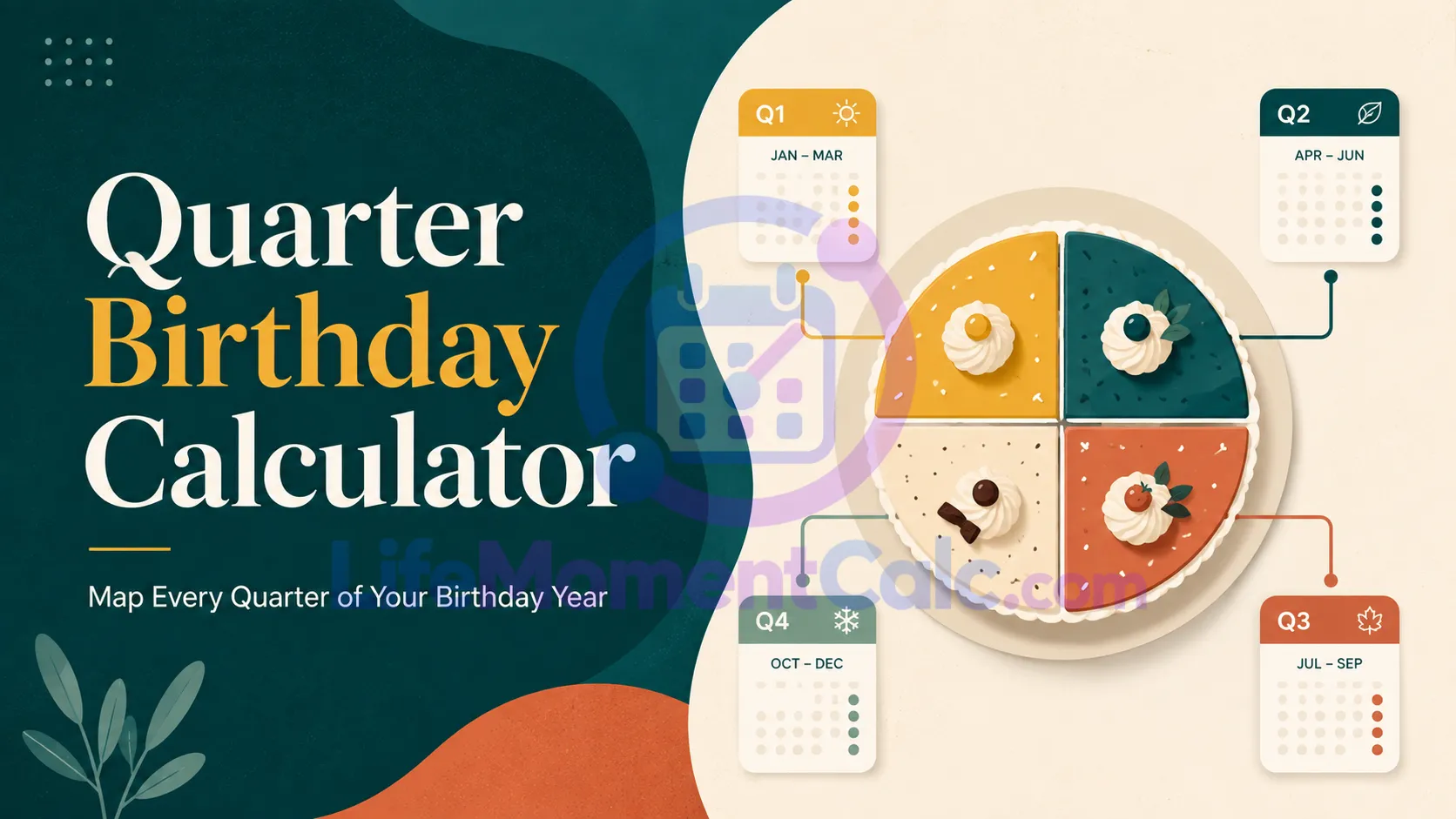
A Quarter Birthday Calculator creates a practical schedule around the birthday year. Instead of showing only the annual birthday, it calculates the milestones three, six, and nine calendar months after each anniversary.
These dates are useful for family records, classroom celebrations, personal reviews, photo projects, recurring reminders, or any plan organized around someone’s birthday rather than the calendar year. The calculator also prevents common errors involving short months and leap-day birthdays.
Generate upcoming one-quarter, half, and three-quarter birthday milestones with adjustment notes. The tool adds three, six, and nine calendar months to each birthday anniversary. Dates on the 29th, 30th, or 31st are clamped only when the destination month is shorter, making every adjustment visible in the result. The one-quarter, one-half, and three-quarter labels describe progress through a birthday year by calendar months. They are not guaranteed to be exact 25%, 50%, or 75% elapsed-time points because calendar months have different lengths.Quarter Birthday Calculator
Quarter-birthday schedule
Calendar-quarter method
What the fractions mean
Build a Four-Part Birthday Year
A birthday begins a new personal year. Adding three calendar months produces the one-quarter birthday, six months produces the half birthday, and nine months produces the three-quarter birthday.
For a May 14 birthday, the straightforward dates are August 14, November 14, and February 14. The weekday changes by year, but the month-and-day pattern normally remains consistent.
The situation becomes more complicated for dates such as May 31. August has a 31st, but November does not. The calculator therefore needs a defined month-end rule rather than informal counting.
Formula Used by the Quarter Birthday Calculator
The tool uses three calendar offsets:
- One-quarter birthday = birthday anniversary + 3 calendar months
- One-half birthday = birthday anniversary + 6 calendar months
- Three-quarter birthday = birthday anniversary + 9 calendar months
For each result, the target day is calculated as:
Target day = minimum of the birthday day and the last valid day of the target month
This means a date is shortened only when necessary. If the original day exists in the target month, it is preserved. If it does not exist, the final valid date is used and the adjustment is reported.
The calculator examines relevant anniversaries around the selected calculation date, gathers upcoming quarter milestones, sorts them chronologically, and identifies the next one.
What Appears in Your Quarter-Birthday Schedule?
Enter the date of birth and the date from which the schedule should be calculated. For a February 29 birthday, select February 28 or March 1 as the anniversary convention used in non-leap years.
The main output identifies the next milestone by name and date. It also displays how many days remain and confirms that the schedule uses three-, six-, and nine-calendar-month offsets.
A detailed table then shows several upcoming milestones with:
- The milestone type
- Its full calendar date
- The number of days until it occurs
- Any last-valid-day adjustment
This makes the tool useful even when the next milestone is only part of a longer plan.
Calendar Quarters Are Not Equal Day Fractions
The words “quarter” and “three-quarter” can suggest exact mathematical fractions. Calendar months, however, are not equally long. Three months may span 89, 90, 91, or 92 days depending on the dates involved and whether February or a leap day falls inside the period.
For that reason, the calculator does not claim that the displayed dates represent exactly 25%, 50%, and 75% of the elapsed days between two birthdays. They represent calendar-month milestones.
If you need the true time midpoint as well as the six-month convention, use the Half Birthday Calculator, which displays both interpretations separately.
Handling Birthdays on the 29th, 30th, or 31st
End-of-month birthdays are where manual quarter-birthday calculations most often fail. Adding three to the month number is not enough because the target month may be shorter.
Suppose someone was born on August 31. The three-month milestone targets November, which has only 30 days. The calculator uses November 30 and marks the adjustment. The six-month milestone targets February and becomes February 28 or 29. The nine-month milestone targets May and can return to the 31st because that day exists.
The earlier adjustment does not permanently change later milestones. Every quarter date is calculated from the relevant birthday anniversary, not from the previously adjusted quarter date.
Useful Ways to Apply the Dates
Parents may use quarterly dates for photographs, growth notes, or small family traditions during a baby’s first years. Teachers can identify an alternative celebration point for a student whose annual birthday falls outside the school term.
Adults may use the dates as personal check-ins. A three-month interval is long enough to evaluate progress but short enough to adjust plans before the next full birthday. The schedule can also support event preparation, gift planning, or recurring calendar reminders.
These milestones remain informal. They do not change a person’s completed age and should not be substituted for an organization’s eligibility policy.
A Schedule Designed for Clarity
The Quarter Birthday Calculator distinguishes calendar arithmetic from elapsed-time fractions, makes short-month adjustments visible, and allows an explicit leap-day policy. That transparency is important because several plausible-looking dates can result from different methods.
Use the calculated dates for celebration and planning. When a contract, school rule, benefit, or legal requirement mentions a fraction of a year, read its exact definition before relying on a general birthday convention.