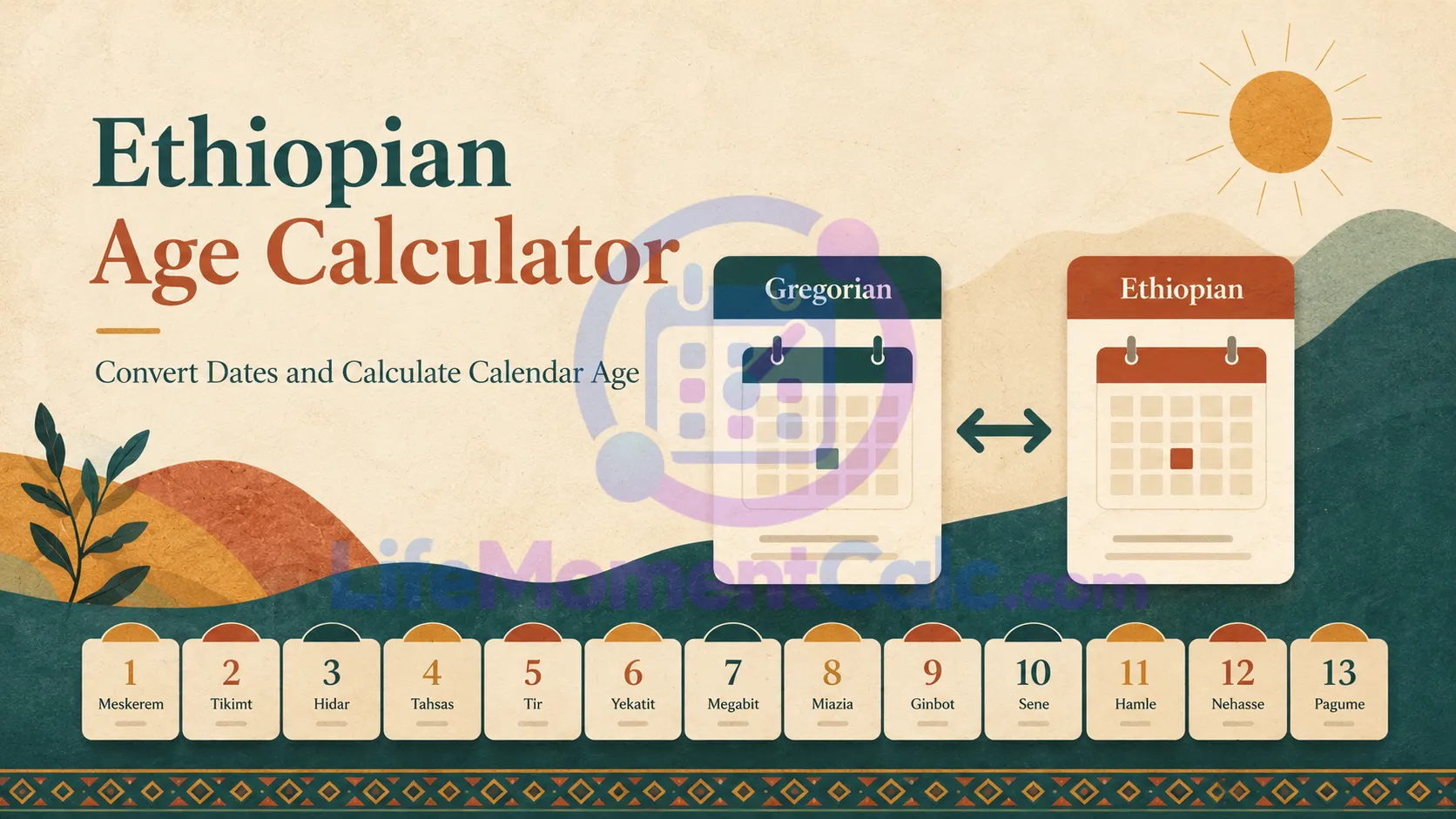
An Ethiopian Age Calculator should account for the Ethiopian calendar’s real month structure rather than subtracting seven or eight from a Gregorian year. The Ethiopian calendar contains twelve 30-day months followed by Pagumen, a short thirteenth month with five or six days.
This tool accepts either a Gregorian birth date or an Ethiopian calendar date. It converts the entry, calculates completed Ethiopian years, months, and days, compares the result with Gregorian chronological age, and finds the next Ethiopian birthday.
Enter a Gregorian or Ethiopian birth date to calculate Ethiopian-calendar age, convert the date, and find the next birthday. The Ethiopian calendar has twelve 30-day months followed by Pagumen, which has five days or six in a leap year. The calculation converts both dates through the browser’s Unicode calendar data and computes completed Ethiopian years, months, and days. Supported inputs correspond approximately to Gregorian 1900–2100. Calendar conversion is suitable for planning and education; confirm dates used on legal, church, immigration, or civil records with the issuing authority.Ethiopian Age Calculator
Ethiopian calendar age
Thirteen-month calendar
Range and verification
Enter the Date in the Calendar You Know
Use the first mode when the birth date appears on a Gregorian record. Enter the date and select the calculation date.
Use the Ethiopian-date mode when you know the Ethiopian year, month, and day. The month selector includes Meskerem through Pagumen, while input validation prevents impossible dates from producing a result.
The supported inputs correspond approximately to Gregorian 1900–2100. A future birth date or unsupported calendar value is rejected.
Formula Used by the Ethiopian Age Calculator
The calculator first converts both the birth date and reference date into Ethiopian calendar components.
Completed Ethiopian age begins with:
Years = reference Ethiopian year − birth Ethiopian year
Months = reference Ethiopian month − birth Ethiopian month
Days = reference Ethiopian day − birth Ethiopian day
If the day result is negative, one Ethiopian month is borrowed. The actual length of the previous Ethiopian month is added to the day result, and the month count is reduced by one.
If the month result is negative:
Months = months + 13
Years = years − 1
This produces completed Ethiopian years, months, and days using the calendar’s 13-month structure. Gregorian age is calculated separately from the converted civil birth date.
Why Subtracting Years Is Unreliable
The Ethiopian and Gregorian new years do not begin on the same date. The numerical difference between their year labels changes during part of the Gregorian year.
A shortcut such as “Gregorian year minus eight” can therefore return the wrong Ethiopian year near the September transition. It also cannot calculate months, days, Pagumen dates, or a precise next birthday.
The calculator avoids this shortcut. It converts calendar components using the browser’s standards-based Ethiopian calendar data and then performs age borrowing inside that calendar.
Pagumen and the Sixth-Day Adjustment
Pagumen normally contains five days and contains a sixth day in an Ethiopian leap year. A person born on Pagumen 6 will not have an identical date in every Ethiopian year.
When the next target year lacks Pagumen 6, the calculator places that birthday on Pagumen 5 and labels the adjustment. It does not allow the date to roll silently into Meskerem.
This is similar in principle to an explicit leap-day policy, but it follows the structure of the Ethiopian calendar rather than Gregorian February.
What Your Result Explains
The main result presents Ethiopian age in years, months, and days. The supporting details show:
- Ethiopian birth date
- Equivalent Gregorian birth date
- Calculation date in the Ethiopian calendar
- Gregorian chronological age
- Next Ethiopian birthday in Gregorian form
- Days until that birthday
- Total days lived
Displaying both calendars is valuable because two correct age descriptions can have different month-and-day components.
When an Ethiopian Age Calculation Is Useful
The tool can support family records, travel preparation, educational work, birthday planning, and cross-calendar communication. It is also helpful when one document uses an Ethiopian date while another uses a Gregorian date.
Someone coordinating a celebration across countries can use the converted date and next-birthday countdown without manually navigating 13 months. Researchers and students can use the result to understand why calendar-aware age differs from simple year subtraction.
For another date system that requires year-specific month data, see the Nepali Age Calculator.
Browser Support and Official Records
The conversion depends on the Ethiopian calendar data included with your browser. The tool checks for that support and displays an error rather than silently switching to Gregorian rules.
Different software environments may contain different versions of international calendar data. The result is suitable for planning and education, but dates used for immigration, legal filings, church observance, civil registration, or identity documents should be confirmed with the responsible authority.
The Ethiopian Age Calculator earns credibility by showing its method and limits. It respects the 13-month calendar, handles Pagumen deliberately, presents both calendar ages, and avoids the misleading idea that Ethiopian age can be found with a single year-offset shortcut.