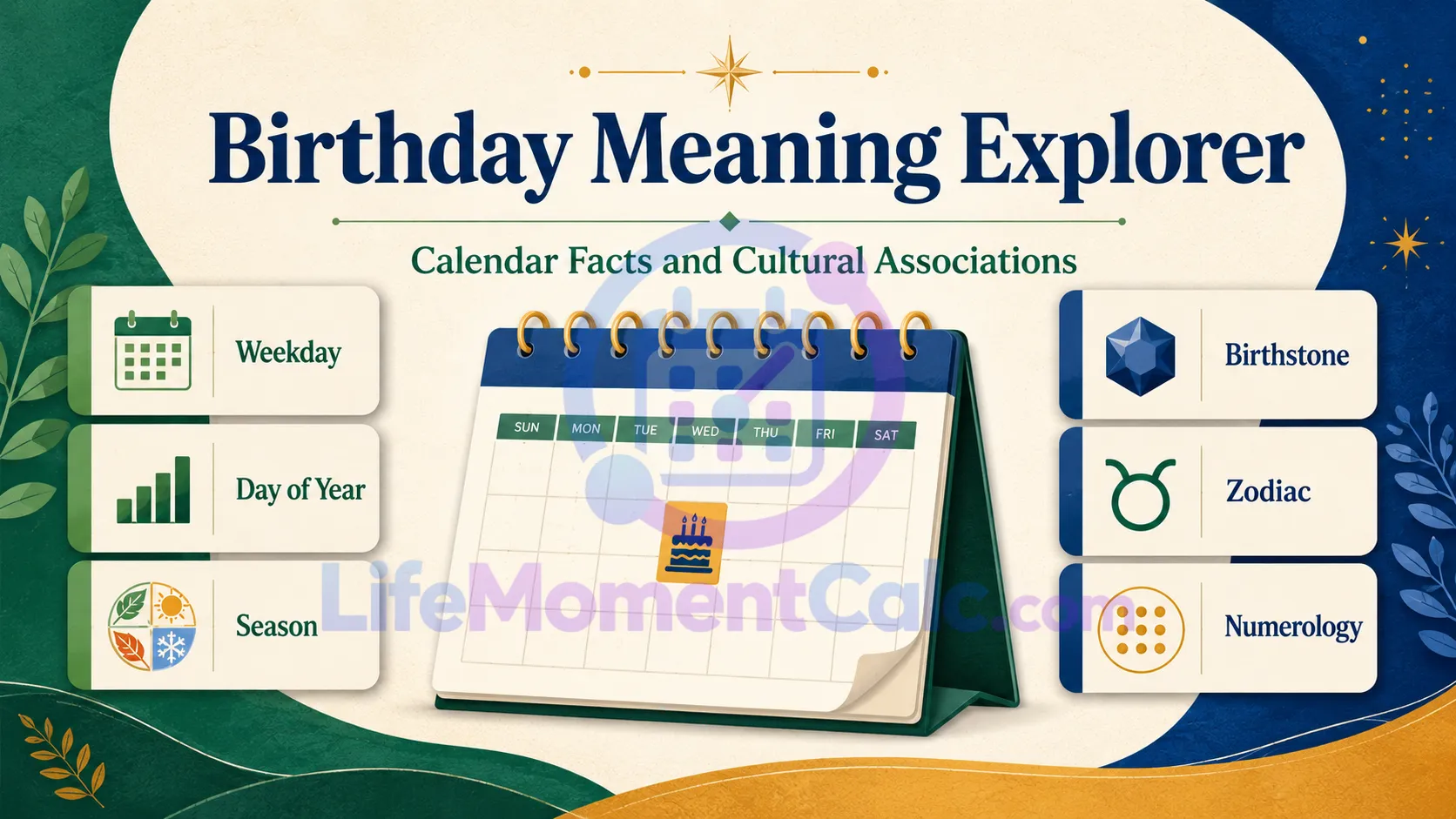
A birthday can be explored through verifiable calendar information and through cultural traditions, but those categories should not be confused. The Birthday Meaning Explorer places both in one result while clearly identifying which details are factual and which are symbolic.
Enter a past date and select a hemisphere to see its weekday, ordinal position in the year, remaining days, leap year status, meteorological season, modern birthstone, tropical zodiac sign, life path, and birthday number.
See factual calendar context alongside clearly labelled birthstone, zodiac, season, and numerology traditions. The result separates verifiable calendar facts—weekday, day of year, remaining days, leap-year status, and season—from cultural associations such as modern birthstones, sun signs, and numerology. Birthstone lists are traditions that have changed over time; astrology and numerology are symbolic practices. The tool presents them as labeled cultural context rather than evidence about behavior, health, ability, or future events.Birthday Meaning Explorer
Birthday fact and symbolism explorer
Facts first
Associations are not destiny
Start with Calendar Facts
The main result begins with the weekday and the date’s ordinal number. An ordinal day states where the date falls within its year: January 1 is day 1, while December 31 is day 365 or 366.
The calculator also shows whether the year was a leap year, how many days remained after the birthday, and which meteorological season contained the date in the selected hemisphere.
These details are produced through Gregorian calendar arithmetic and do not depend on symbolic interpretation.
Calendar and Numerology Formulas Used
Gregorian Leap Year
A year is treated as a leap year when it is divisible by 4, except century years must also be divisible by 400:
Leap year = divisible by 4 AND (not divisible by 100 OR divisible by 400)
A leap year contains 366 days; an ordinary year contains 365.
Day of Year
Day of year = floor((selected date − January 1) ÷ 86,400,000 milliseconds) + 1
Days Remaining
Days remaining = days in year − day of year
This counts the days after the selected date, so December 31 returns zero.
Life Path
The eight digits of YYYYMMDD are added and repeatedly reduced, preserving final master numbers 11, 22, and 33.
Life path = reduced sum of all birth date digits
The birthday number separately reduces the day of the month under the same convention.
How Hemisphere Changes the Season
The tool uses meteorological seasons, which group complete months. In the Northern Hemisphere, March through May is spring, June through August is summer, September through November is autumn, and December through February is winter.
The Southern Hemisphere reverses those labels. A July birthday is therefore in meteorological summer in the north but winter in the south.
This is different from astronomical seasons, whose start dates depend on solstices and equinoxes and can vary slightly by year and time zone.
Birthstones as a Modern Tradition
The result displays one or more modern birthstones associated with the birth month. Some months have several accepted stones. June, for example, includes pearl, alexandrite, and moonstone in the list used by the plugin.
Birthstone associations developed and changed across cultures and periods. They are presented as a modern tradition rather than a mineralogical property caused by someone’s date of birth.
Zodiac and Numerology Context
The month and day identify one tropical sun sign with an associated element. The full date produces the life path, while the day produces the birthday number.
These are symbolic systems. They can be used for journaling, celebration themes, or cultural exploration, but they are not verified measurements of intelligence, personality, health, or future success.
For a more detailed symbolic profile with strengths and balancing questions, use the Birthday Personality Calculator. To investigate the Moon’s astronomical phase at a specific time, try the Birthday Moon Phase Calculator.
A Better Way to Read the Full Result
Begin with the factual layer: weekday, day number, year length, remaining days, and season. These values can be checked through calendar arithmetic.
Next, examine the cultural layer: birthstone, zodiac sign, life path, and birthday number. Treat these as traditions that may or may not feel personally relevant.
Separating the layers lets the page offer a rich birthday overview without presenting every item as the same kind of knowledge.
Helpful Uses for Birthday Details
The output can support birthday cards, biography pages, family history projects, classroom calendar exercises, party themes, personalized gifts, or simple curiosity.
A weekday can add context to a historical timeline. The ordinal day may work in a numbered keepsake. A birthstone can inspire a color palette, while zodiac or numerology themes can provide optional creative language.
Avoid publishing a living person’s full date of birth without permission. Combining a birth date with other identifying details can create privacy concerns.
Frequently Asked Questions
Is the season based on the exact birthplace?
The result uses the selected Northern or Southern Hemisphere and meteorological month groups. It does not calculate local climate or the exact astronomical season transition.
Why do some months have multiple birthstones?
Modern lists recognize more than one stone for several months due to historical updates and overlapping traditions.
Does the weekday change by time zone?
The tool treats the entered value as a Gregorian civil date. A person born near midnight may have a different recorded date elsewhere, but the selected date itself has one calculated weekday.
Are birthday meanings scientifically proven?
The calendar facts are mathematical. Birthstones, zodiac signs, and numerology are cultural or symbolic associations, not scientific personality findings.