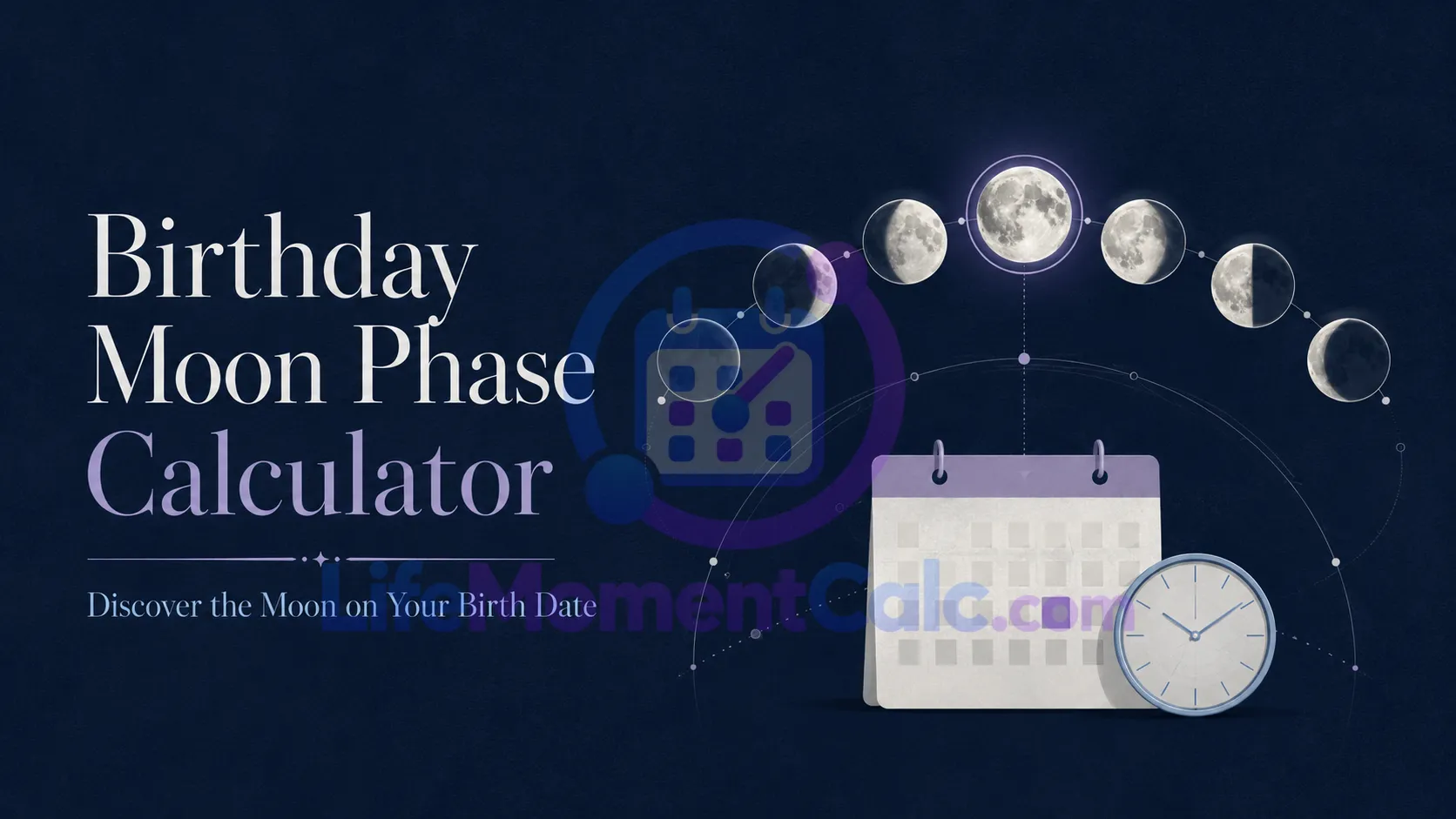
The Moon changes continuously as it travels through its cycle, so two people born only a few days apart may have very different birth moon results. The Birthday Moon Phase Calculator estimates the lunar phase for a specific date, time, and UTC offset rather than assigning one phase to an entire calendar day.
Enter your birth details to discover whether the Moon was new, crescent, quarter, gibbous, or full. The result also includes the estimated illuminated fraction, waxing or waning direction, lunar age, Julian Date, and approximate number of days until the next full moon.
Estimate the Moon’s phase, illumination, waxing or waning direction, lunar age, and time to the next full moon. The tool converts the entered civil date and offset to an instant, estimates geocentric solar and lunar coordinates, and derives the illuminated fraction and position in the synodic cycle. It reports one of eight familiar phase bands plus the continuous illumination value. A phase can cross a boundary during a calendar day. Noon UTC is provided only as a neutral default; enter the known local time and historical UTC offset for a more relevant result. The calculation is suitable for birthday exploration, not navigation or observatory work.Birthday Moon Phase Calculator
Moon phase details
Method and precision
Why time and offset matter
How to Use the Birthday Moon Phase Calculator
Choose your date of birth and enter the most accurate birth time available. Next, provide the UTC offset that applied at the birthplace on that historical date. UTC offsets can include fractional hours, such as +5.5 or +5.75.
The default time is noon, which is useful when the exact time is unknown. However, it should not be interpreted as the actual birth time. Lunar phases can cross a descriptive boundary during the same date, making time and historical offset especially important near a new moon, quarter moon, or full moon.
Select Calculate moon phase to generate the result. Nothing needs to be downloaded, and the calculation runs locally in the browser.
Formula and Astronomical Method Used
The tool first converts the entered civil date and time into a UTC instant by subtracting the supplied offset. It then converts that instant to a Julian Date:
Julian Date = Unix milliseconds ÷ 86,400,000 − 0.5 + 2,440,588
Approximate solar and lunar coordinates are calculated relative to the J2000 astronomical reference epoch. From the angular relationship between the Sun and Moon, the calculator derives the phase angle and illuminated fraction:
Illuminated fraction = (1 + cos(incidence angle)) ÷ 2
The result is multiplied by 100 to display illumination as a percentage. The tool also calculates a continuous position within a synodic month, using an average cycle length of 29.530588853 days.
Lunar age = cycle position × 29.530588853
Days to full moon = mod(0.5 − cycle position, 1) × 29.530588853
Finally, the continuous position is assigned to one of eight familiar phase bands: New Moon, Waxing Crescent, First Quarter, Waxing Gibbous, Full Moon, Waning Gibbous, Last Quarter, or Waning Crescent.
Understanding Your Birth Moon Result
The phase name provides a recognizable description, while the illumination percentage gives more precise context. A waxing crescent, for example, may range from a very thin crescent to nearly half illuminated. The continuous percentage helps distinguish those different points within the same named phase.
“Waxing” means the illuminated fraction was generally increasing. “Waning” means it was decreasing. Lunar age measures the approximate time since the beginning of the current cycle, not the Moon’s physical age.
The displayed Julian Date is a continuous astronomical day count used to represent an exact instant consistently. It is included for transparency and can help when comparing the result with another astronomical calculation.
Why Birth Time and UTC Offset Can Change the Answer
A calendar date is not one universal instant. Midnight in Dhaka, London, and New York occurs at different moments in UTC. Historical daylight saving rules can also mean that a location’s present offset was not the offset used on the birth date.
If the Moon was well inside a phase band, a small time difference may not change the phase name. Close to a boundary, it can. When the birth time is uncertain, compare several plausible times and treat any changing phase label as an indication that the transition occurred around that date.
For more factual and symbolic date context, the Birthday Meaning Explorer can show the weekday, ordinal day, season, birthstone tradition, zodiac sign, and numerology values associated with the same birthday.
Accuracy and Appropriate Use
This Birthday Moon Phase Calculator uses a lightweight geocentric astronomical approximation. It is designed for birthday exploration, personal projects, journaling, and educational comparison. It is not a precision ephemeris and should not be used for navigation, eclipse prediction, scientific observation planning, or moonrise and moonset calculations.
The output describes the Moon from a geocentric perspective. It does not model the observer’s horizon, local weather, atmospheric refraction, or the Moon’s visual orientation from a particular latitude. A phase can also look different depending on hemisphere and viewing angle even when its astronomical illumination is the same.
Frequently Asked Questions
Can the Moon phase be calculated without a birth time?
Yes. Keep the noon default and understand that it is an estimate for the middle of the date. If the result lies near a phase boundary, the exact birth time could produce a different phase name.
Does a full moon result mean the Moon looked completely full all night?
Not necessarily. The exact full moon instant may occur during daylight or between local moonrise and moonset. The result estimates the phase at the time entered.
Is a birth moon a scientific personality indicator?
No. The phase calculation is astronomical, but personality meanings attached to birth moon phases are cultural or spiritual interpretations. The calculator reports astronomical quantities without treating them as evidence of personality, compatibility, or future events.