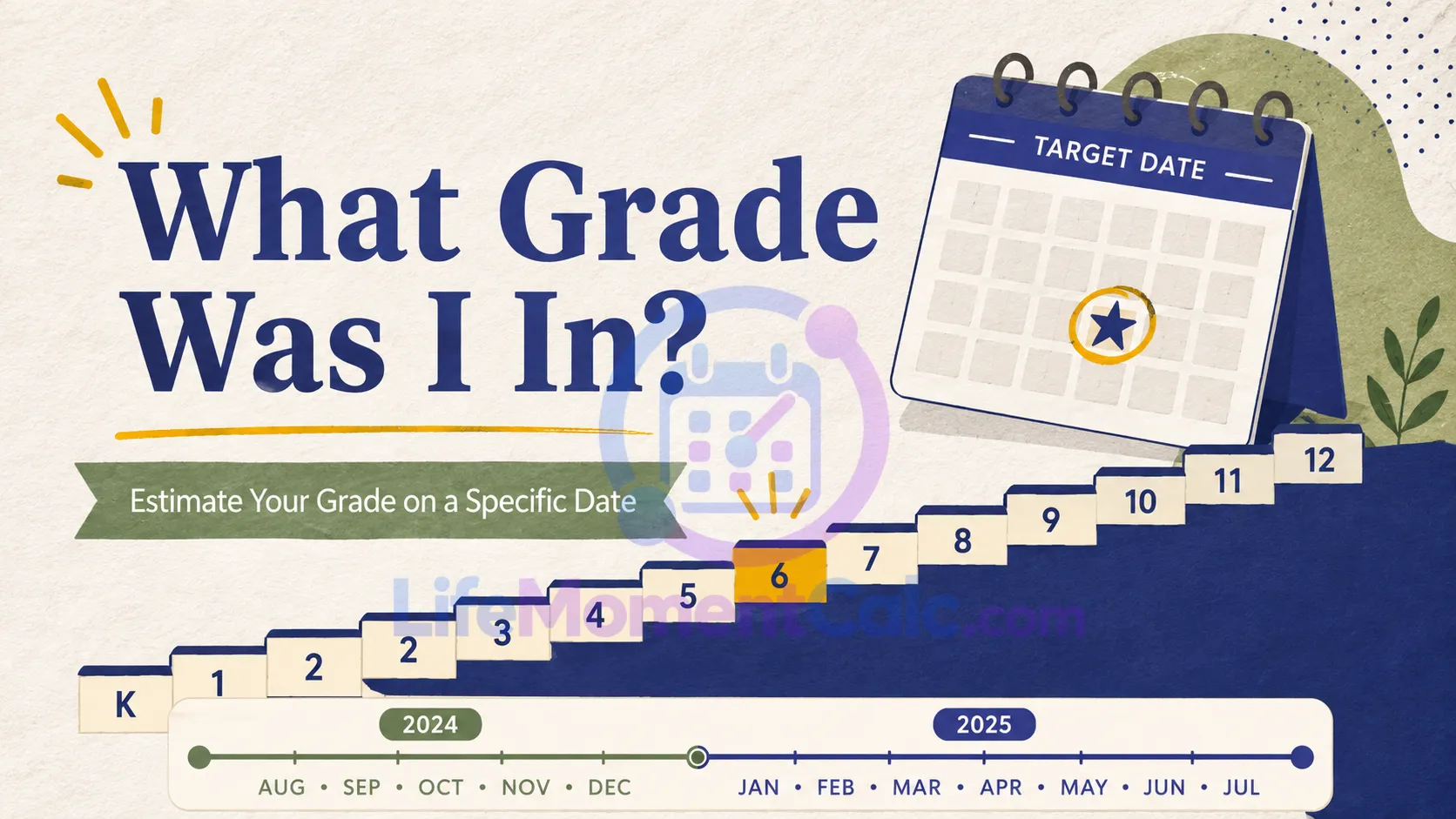
A calendar year often includes parts of two different school years. That makes the question “What grade was I in during 2015?” incomplete without a month and day. The What Grade Was I In? tool uses a specific target date to estimate likely placement.
The calculation combines birth date, kindergarten entry age, enrollment cutoff, school-year starting date, and an optional early or delayed progression adjustment. It then generates a complete kindergarten-through-12th-grade timeline so the underlying assumptions remain visible.
Estimate the grade for a specific date and generate a complete kindergarten-through-12th-grade timeline. A calendar year can span two grades. The target date lets the tool distinguish the spring portion of one school year from the fall portion of the next. The full K–12 table also makes the assumption visible. The calculation assumes uninterrupted annual progression after kindergarten. Cutoffs and enrollment decisions vary, so the result is a likely timeline rather than an official transcript.What Grade Was I In?
Likely grade and timeline
Why a date matters
Estimated placement
Why a Target Date Produces a Better Estimate
Consider a student who was in 7th grade during spring 2015 and began 8th grade that autumn. A year-only calculator could reasonably return either grade.
By asking for a complete target date, this tool determines whether the date occurred before or after the selected start of the school year. The resulting placement is tied to the correct academic-year segment rather than the calendar year alone.
You can adjust the school-year start because academic calendars differ. The default is a planning assumption, not a statement that every school opens on the same date.
Actual Calculation Method
Step 1: Estimate Kindergarten Eligibility
The selected entry age is added to the birth date. That birthday is compared with the eligibility cutoff in the same year.
If the child reaches the entry age on or before the cutoff, kindergarten is estimated to begin that year. If the birthday falls after the cutoff, the start moves to the next year.
Kindergarten year = Eligibility year + Cutoff adjustment + Progression adjustment
The progression adjustment may move the timeline one year earlier, leave it unchanged, or move it one year later.
Step 2: Identify the Target School Year
The tool places the school-year start in the target date’s calendar year. If the target date falls before that boundary, the academic year is treated as having begun in the previous calendar year.
School-year start = Target year or Target year − 1
Step 3: Estimate the Grade
Estimated grade number = School-year start − Kindergarten start year
Kindergarten is represented by 0, Grade 1 by 1, and so forth through Grade 12.
A negative result means the target date was likely before kindergarten. A result above 12 indicates that a standard uninterrupted K–12 sequence was likely complete.
What the Timeline Shows
The primary result reports likely placement on the target date. Supporting details identify the target school year, estimated kindergarten start, and projected high-school class year.
A full table then lists:
- Kindergarten through Grade 12
- The starting and ending year of each school year
- The calendar year in which each grade normally ends
This table is especially useful when reconstructing educational history, organizing family records, writing a biography, or checking when a school-related event probably occurred.
For a focused completion estimate, use the Graduation Year Calculator.
Adjusting for a Known Early or Late Start
If the student began kindergarten one year later than the standard assumption, choose the delayed-start adjustment. If the student entered one year early, select the early-start option.
This adjustment shifts the full timeline. It should not be used merely because someone was older or younger than classmates; use it only when the enrollment history supports the change.
A single adjustment cannot represent multiple retained or skipped grades. In that situation, the generated table can still be used as a baseline, but individual years must be corrected manually.
Why the Result Is an Estimate
School-entry requirements vary by country, state, province, district, institution, and academic year. Enrollment decisions may consider readiness, available places, parental requests, transfers, or exceptions.
Other school systems may not use the same kindergarten-to-Grade-12 structure. Some begin the academic year in a different season, use different grade names, or divide primary and secondary study differently.
The calculator does not access a transcript, school database, or government record. It models standard annual progression from the values entered.
Improving the Accuracy
Use the cutoff and school-year start that applied to the relevant school system at the time. If possible, verify the actual kindergarten starting year from family records.
After generating the table, compare one known grade or school event with the projection. If every row is shifted by one year, review the cutoff and progression adjustment.
Frequently Asked Questions
Why does the tool ask for the month and day?
A calendar year spans portions of two school years, so the date determines which side of the school-year boundary applies.
Does the timeline prove which grade was attended?
No. It is an estimate based on uninterrupted progression and the assumptions entered.
Can it calculate a grade before kindergarten?
It reports that the person was likely not yet in kindergarten.
Does Grade 12’s ending year equal the graduation year?
Under the selected standard progression, yes. Actual completion can differ because of local program rules or enrollment history.