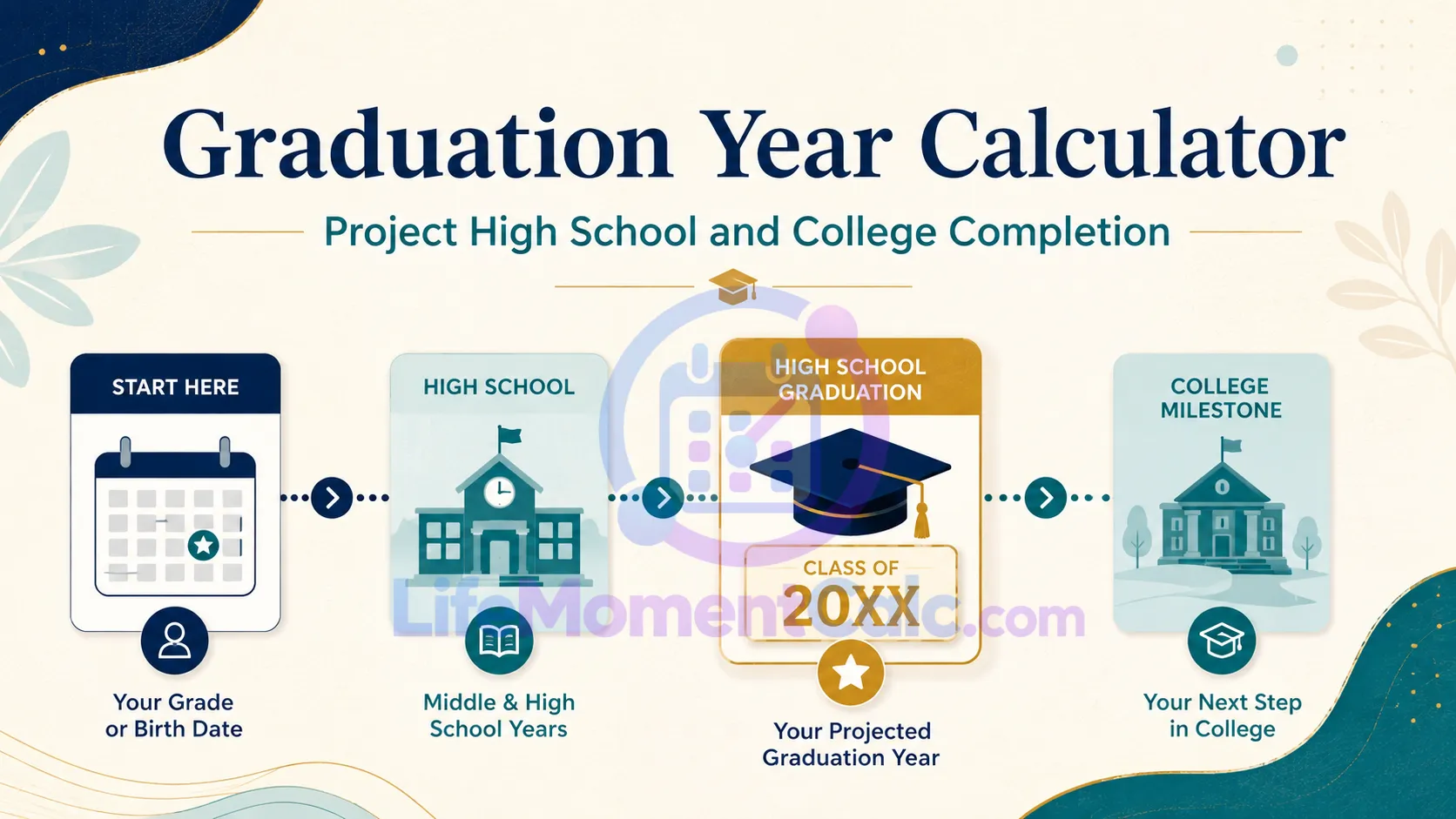
The Graduation Year Calculator estimates when a student may complete high school using either a known current grade or a date of birth. It can also add an optional two-, four-, five-, or six-year college projection to the estimated high-school completion date.
A useful graduation estimate needs more than a birth year. School-entry cutoffs, kindergarten age, academic-year boundaries, delayed enrollment, and accelerated placement can all affect the timeline. This calculator therefore displays its assumptions instead of presenting one unexplained class year.
Project a high-school graduation year from a current grade or birth date, with an optional college estimate. The grade method adds the remaining grades in a standard K–12 sequence. The birth-date method first estimates kindergarten eligibility from the selected entry age and cutoff, then builds the timeline. Graduation is shown as the calendar year in which the academic year normally ends. School entry rules vary by state, country, district, and year. Redshirting, retention, acceleration, transfers, and non-standard programs can change the result. Treat a birth-date result as a planning estimate and confirm it with the school.Graduation Year Calculator
Projected graduation timeline
How the projection works
Important limitation
Choose the Best Starting Point
Use Current Grade mode when the student’s grade and the academic year in which that grade began are known. This is usually the more direct route because it does not need to estimate kindergarten eligibility.
Use Birth Date mode when the current grade is unavailable or when planning for a younger child. Enter the date of birth, assumed kindergarten entry age, school eligibility cutoff, and any early or delayed enrollment adjustment.
The optional college estimate begins after the projected high-school graduation year. It represents uninterrupted study for the selected program length and does not model gap years, transfers, part-time enrollment, prerequisite programs, or changes of major.
Formula Used by the Graduation Year Calculator
Projection from a Current Grade
Let G be the current grade and A be the starting year of the current academic year.
High-school graduation academic-year start = A + (12 − G)
Graduation calendar year = Graduation academic-year start + 1
If a student begins 9th grade in the 2026–2027 academic year:
2026 + (12 − 9) = 2029
The projected senior academic year is 2029–2030, producing a graduation calendar year of 2030.
Projection from a Birth Date
The calculator first adds the selected kindergarten entry age to the birth date. It compares that birthday with the eligibility cutoff in the same year.
If the child reaches the selected age on or before the cutoff, that year becomes the estimated kindergarten starting year. Otherwise, the estimate moves to the following year. An early or delayed enrollment adjustment of −1, 0, or +1 is then applied.
Projected high-school graduation year = Kindergarten start year + 13
The thirteen-year span represents kindergarten followed by Grades 1–12.
Projected college completion = High-school graduation year + Selected college duration
Reading the Graduation Projection
The main result displays an expected graduating class, such as Class of 2030. Supporting details identify the high-school academic year, graduation calendar year, and optional college completion year.
Birth-date mode also reports the estimated kindergarten start. This detail makes it easier to check whether the entire timeline begins with a reasonable school-entry assumption.
The result is a planning projection rather than an official enrollment decision. If the kindergarten year is already known, compare it with the estimate. A one-year difference at the beginning normally shifts every later grade and graduation date by one year.
The What Grade Was I In? tool can generate a complete kindergarten-through-12th-grade table and estimate placement on a particular date.
Why Graduation Years Can Differ
Enrollment rules are controlled by local education systems. Two districts may use different cutoff dates, and a rule may change between academic years. Families may also choose delayed entry where permitted.
Other events that can change a graduation timeline include:
- Grade retention or acceleration
- Transfers between school systems
- Homeschooling or alternative programs
- Different secondary-school structures
- Interrupted attendance
- Credit recovery or early graduation
- Program-specific completion requirements
Because these factors are not available from a birth date alone, the calculator does not claim to reproduce an official student record.
Using the College Estimate Responsibly
The college option adds a selected number of years to high-school completion. A four-year choice means four calendar years after the projected high-school graduation year; it does not evaluate degree credits.
Many students complete programs on different schedules. Cooperative education, internships, prerequisite study, part-time attendance, course availability, and personal decisions may extend or shorten the timeline.
Use the college result for broad planning, not applications, financial-aid deadlines, immigration documents, or claims about a guaranteed completion date.
Practical Ways to Use the Result
A graduation-year estimate can help organize savings goals, family planning, school-transition research, or a long-range academic timeline. Older students may use current-grade mode to confirm a likely class year, while families of younger children can compare several cutoff or entry-age scenarios.
Once the actual event date is confirmed, the Graduation Invitation Generator can create a personalized invitation with print and SVG-download options.
Frequently Asked Questions
Is graduation year based only on age?
No. Birth-date mode also uses kindergarten entry age, eligibility cutoff, and enrollment adjustment.
Which year should be entered as the academic year?
Enter the calendar year in which the current academic year began. For 2026–2027, enter 2026.
Does the result account for repeating or skipping a grade?
Use the one-year adjustment when appropriate, but more complex histories require manual correction.
Is the college completion year official?
No. It is an optional duration-based projection and does not evaluate credits or institutional requirements.