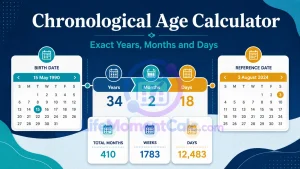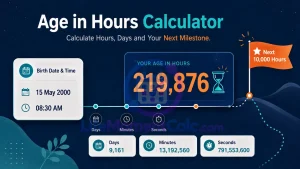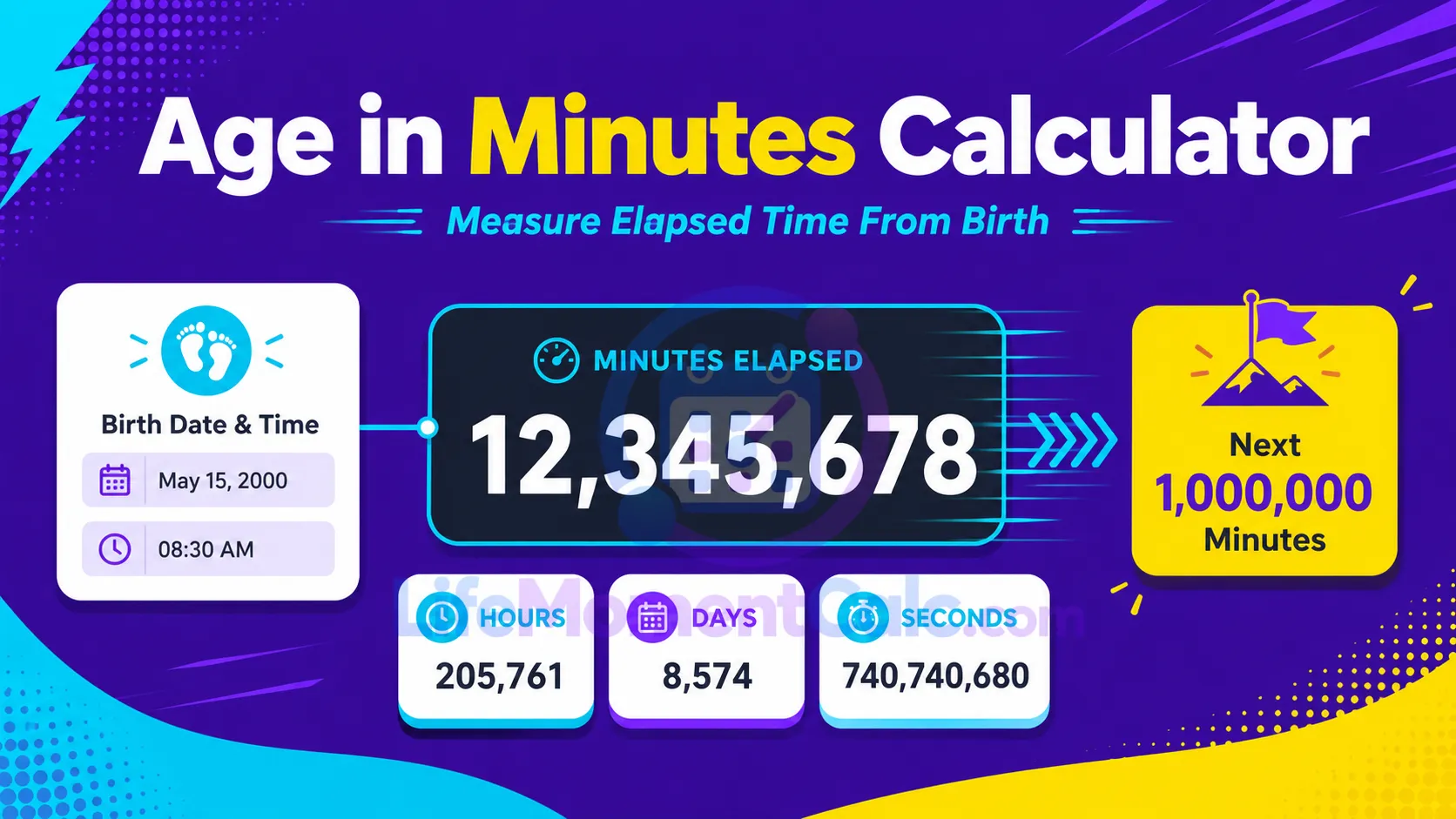
The Age in Minutes Calculator measures the elapsed instant between a birth date and time and a reference date and time. It reports completed minutes plus related totals in hours, days, and seconds.
If the exact birth time is unknown, the result can be visibly labelled as an estimate from midnight. The tool also identifies the next one-million-minute milestone and its expected date and time.
Calculate elapsed minutes from a birth date and time, with clear handling when the birth time is unknown. The calculation uses the two browser-local date-time values as instants and converts the millisecond difference into full and decimal minutes. Days, hours, seconds, and the next million-minute milestone are included. For exact lifetime minutes, the original birth time and its time zone are required. If the birth time is unknown, select the estimate option. Historical daylight-saving and time-zone rule changes are handled only to the extent supported by the visitor’s browser.Age in Minutes Calculator
Age in minutes
Elapsed-time calculation
Time-zone limitation
Exact Minutes Require More Than a Birth Date
A date alone covers 1,440 possible birth minutes. Using midnight without disclosure can introduce an error of nearly a full day.
Enter the recorded birth time when available. Leave the reference field blank to calculate through the current moment, or enter a historical or future reference time after birth.
If the birth time is unknown, select the estimate option. This does not change the entered midnight value; it changes the result label so the displayed precision is not misleading.
Formula Used for Age in Minutes
The browser interprets both local date-time values as instants. Let B be the birth instant in milliseconds and R the reference instant.
Elapsed milliseconds = R − B
Total seconds = Elapsed milliseconds ÷ 1,000
Total minutes = Elapsed milliseconds ÷ 60,000
Total hours = Elapsed milliseconds ÷ 3,600,000
Total days = Elapsed milliseconds ÷ 86,400,000
The headline uses:
Completed minutes = floor(Total minutes)
Suppose exactly 90 minutes have elapsed:
5,400,000 milliseconds ÷ 60,000 = 90 minutes
The same duration is 1.5 hours and 5,400 seconds.
How the Million-Minute Milestone Is Found
The next milestone is the next multiple of 1,000,000 above the current minute total:
Next milestone = ceiling(Current minutes ÷ 1,000,000) × 1,000,000
If the current value is already exactly a multiple of one million, another million is added so the result points to a future milestone.
Minutes remaining = Next milestone − Current minutes
The remaining minutes are converted back into milliseconds and added to the reference instant to produce the milestone date and time.
One million minutes equals approximately 694.44 fixed 24-hour days, but the displayed milestone is calculated from the entered instants rather than a rounded calendar estimate.
Understanding Local Time and Time Zones
A datetime-local field does not include a named time zone. The browser interprets it within the local environment.
If the birthplace used a different time zone, entering its clock reading on a device configured elsewhere may not represent the correct instant. Historical daylight-saving and offset rules add further complexity.
For the most accurate lifetime-minute calculation, convert both values into a consistent time zone before entering them or perform the calculation on a device configured for the intended zone. The browser’s time-zone database controls historical interpretation.
What the Result Shows
The headline reports completed minutes. Supporting values include completed hours, completed days, total seconds, and the next one-million-minute milestone.
Completed hours and days are whole-unit counts. The total seconds value is also floored for display. These are alternative views of the same elapsed duration and should not be added together.
The Age in Hours Calculator focuses on completed hours and the next 10,000-hour milestone.
Appropriate Uses and Limitations
The result can support personal curiosity, birthday projects, time-based milestones, or date-time checking. It is not appropriate for legal age, medical decisions, billing, employment records, or scientific timing when the underlying time zone or birth time is uncertain.
No date-time calculator can recover an unknown birth time. Selecting the estimate label is therefore more honest than displaying an apparently exact result.
Frequently Asked Questions
Does the tool update continuously?
It calculates when submitted. Recalculate later to refresh a current-time result.
Why can the result differ on another device?
The devices may use different time-zone settings or historical time-zone data.
Is the birth minute counted as a completed minute?
No. Completed minutes measure elapsed 60-second intervals after the birth instant.
Can a future reference date be entered?
Yes, provided it occurs after the birth date and time.