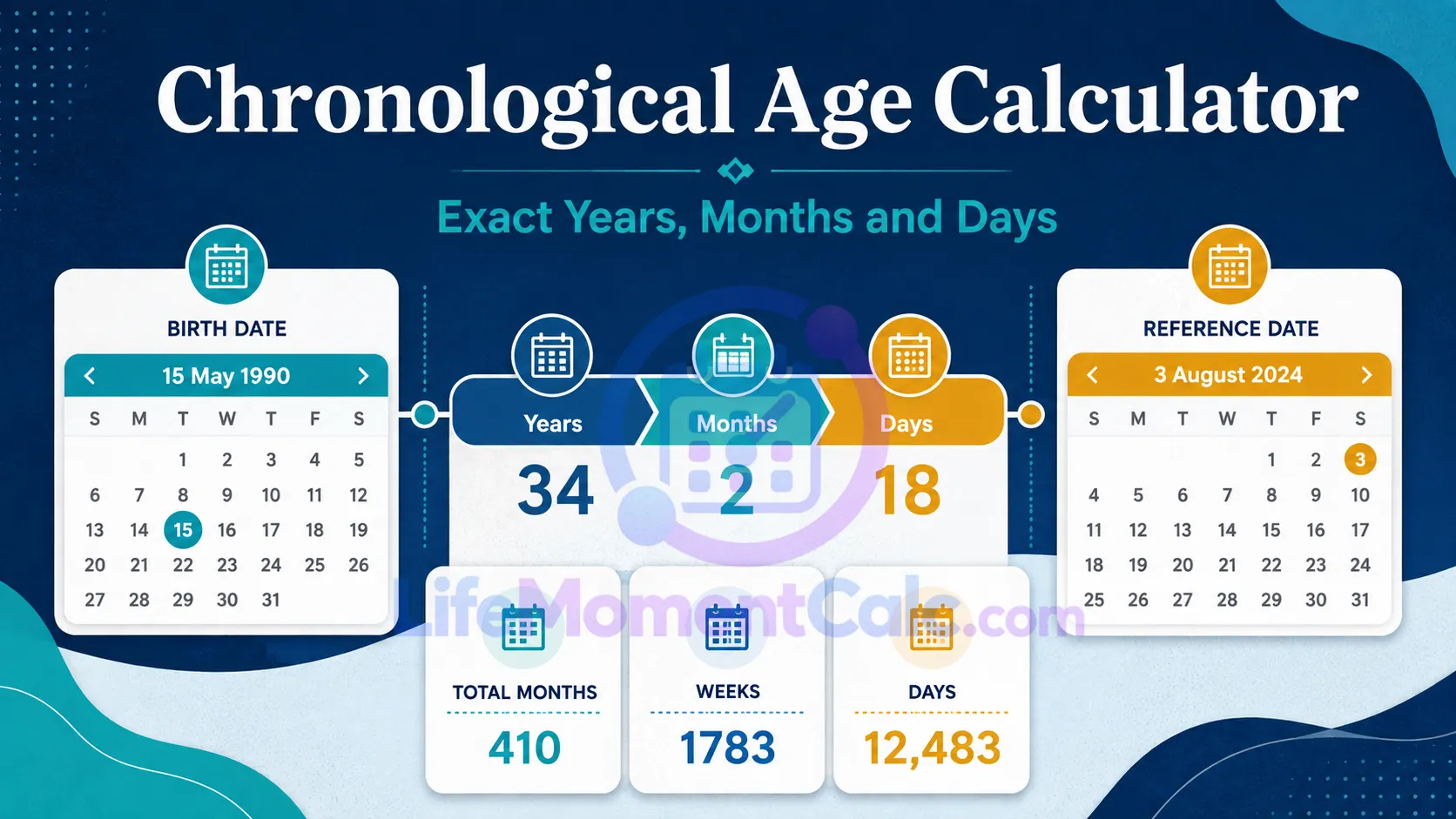
Chronological age is the elapsed calendar interval between a date of birth and a reference date. The Chronological Age Calculator expresses that interval in completed years, completed months, and remaining days instead of treating every year or month as the same length.
It also reports completed months, full weeks with extra days, total elapsed days, and the next birthday. A selectable February 29 convention makes leap-day handling visible rather than silently choosing an anniversary date.
Calculate exact age in years, months, and days, plus total months, weeks, days, and the next birthday. The primary result counts completed years, then completed calendar months, then remaining days. Total days are calculated separately, so variable month lengths and leap years are not approximated. Rules for when a leap-day birthday is legally attained in a non-leap year can vary. Select the convention required for your purpose and verify legal or eligibility decisions with the relevant authority.Chronological Age Calculator
Exact chronological age
Calendar-accurate age
Leap-day birthdays
Enter the Date on Which Age Matters
The reference date may be today or another date relevant to an application, assessment, record, or historical question. It must not occur before the date of birth.
Date-only calculation deliberately ignores time of day. Someone may therefore be shown as having reached a birthday on the selected civil date even if the exact birth time has not yet occurred. For sub-day elapsed time, use the Age in Hours Calculator or Age in Minutes Calculator.
Formula and Calendar Method Used
Chronological age is calculated through calendar anchors rather than one fixed divisor.
First, the tool subtracts the birth year from the reference year. It creates the corresponding birthday in that reference year. If that anniversary occurs after the reference date, one year is removed.
Completed years = Largest whole Y where Birth date + Y years ≤ Reference date
Starting from that year anniversary, it adds calendar months until another complete month would exceed the reference date:
Completed months = Largest whole M where Year anchor + M months ≤ Reference date
Finally:
Remaining days = Reference date − Month anchor
The primary result is therefore:
Completed years + Completed months + Remaining days
Total days are calculated independently from the normalized civil dates:
Total days = Reference date serial day − Birth date serial day
Additional totals are:
Completed months = Years × 12 + Months
Full weeks = floor(Total days ÷ 7)
Extra week days = Total days mod 7
Why This Is More Accurate Than Simple Multiplication
Multiplying age in years by 365 ignores leap days. Multiplying years by 12 and adding a fraction can also misrepresent calendar months, which contain 28, 29, 30, or 31 days.
A person can be 20 years, 1 month, and 3 days old while having a total-day count that differs from another person with the same displayed components because their intervals include different leap years and month lengths.
The calculator keeps calendar age and total elapsed days separate so each value answers the appropriate question.
February 29 Anniversary Options
For a February 29 birth date, the anniversary does not exist in most years. The form allows either February 28 or March 1 to represent the non-leap-year anniversary.
The selection affects completed years and the next-birthday countdown around that boundary. It does not determine a universal legal rule. Legal age, eligibility, benefits, and deadlines may follow jurisdiction-specific legislation or administrative policy.
Use the convention required by the organization receiving the result and verify high-stakes decisions directly.
Understanding Every Output
The headline gives age in years, months, and days. “Completed months” converts only the completed calendar-year and month components into a single count.
The full-week result is based on total days, not completed months. It displays whole seven-day blocks and the remaining days.
“Next birthday” reports the next anniversary under the selected leap-day rule and the number of civil days from the reference date.
These outputs should not be added together. They are alternative representations of the same interval.
Suitable Uses
The Chronological Age Calculator can support routine age checks, family records, historical calculations, educational forms, and preparation for assessment dates.
It provides date arithmetic only. It does not decide legal majority, school placement, medical dosage, developmental expectations, insurance eligibility, or official age under a particular regulation.
For age expressed through an average year length, use the Decimal Age Calculator.
Frequently Asked Questions
Does the calculation include the birth date as one full day?
No. Total elapsed days measure the difference between the two civil dates.
Why do online age calculators sometimes disagree?
They may use different leap-day policies, inclusive counting, time zones, or simplified month rules.
Can age be calculated on a future date?
Yes, provided the reference date is on or after the birth date.
Is completed age different from running age?
This tool reports completed calendar years. Informal “running age” terminology varies and is not used.