The Decimal Age Calculator expresses elapsed age as one continuous number, such as 18.742 years. It divides exact elapsed civil days by a selected year-length convention rather than converting completed calendar months into a decimal.
You can choose the mean Gregorian year, exact Julian year, or fixed 365-day convention and display two, three, four, or six decimal places. Calendar age appears beside the decimal result to clarify the difference between these representations.
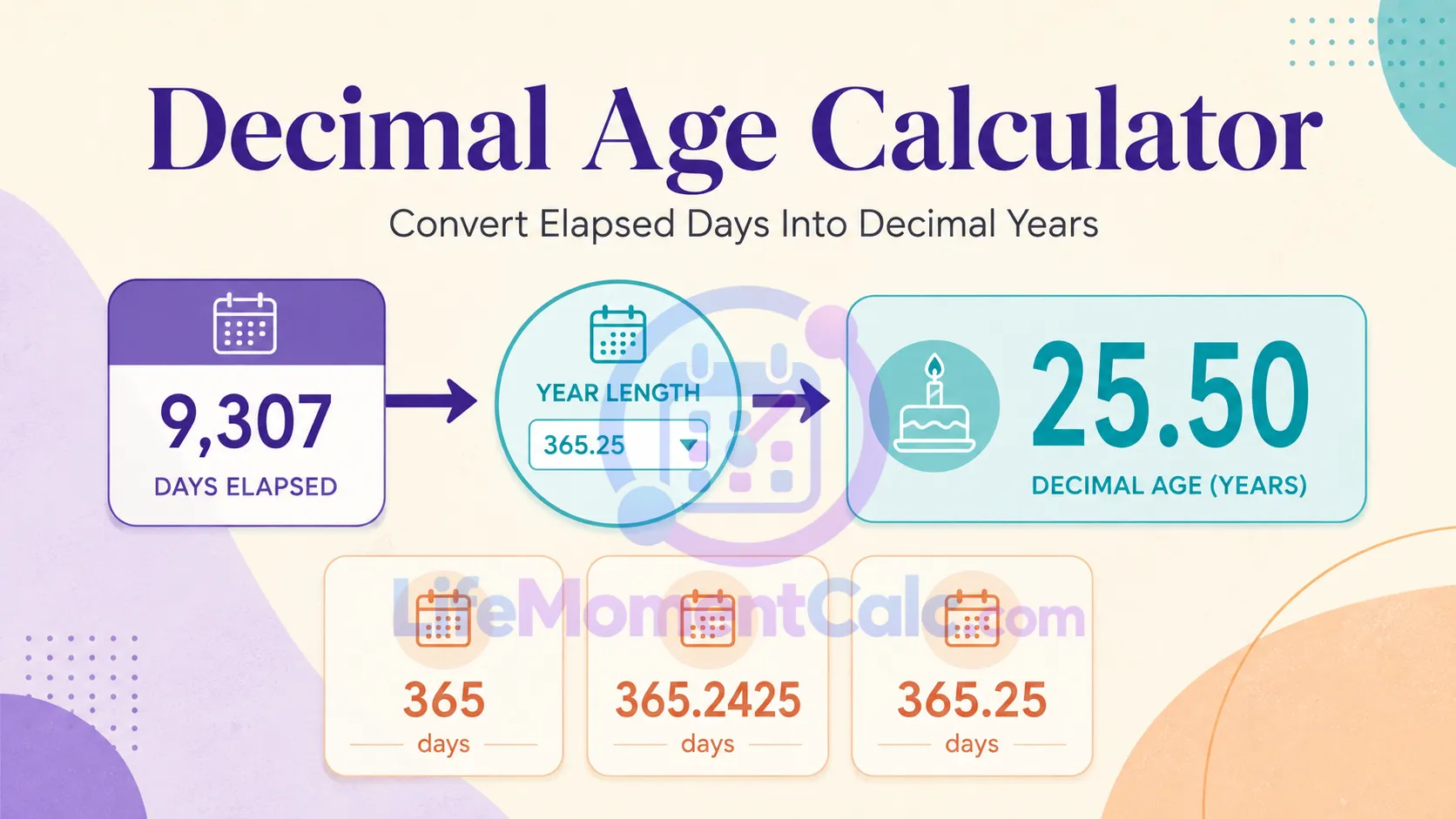
Express elapsed age as a decimal using a transparent year-length convention and selectable precision. Decimal age equals elapsed civil days divided by the selected year length. The default 365.2425 days is the mean Gregorian calendar year; 365.25 is the exact Julian-year convention used in some scientific contexts. A decimal such as 25.50 represents half of the selected average year, not necessarily six calendar months. Use the accompanying calendar-age result when exact month and day boundaries matter.Decimal Age Calculator
Decimal age
Method
Not the same as calendar months
Formula Used for Decimal Age
Let D be the number of elapsed civil days and B be the selected number of days per year.
Decimal age = D ÷ B
The available bases are:
- 365.2425 days: mean Gregorian calendar year
- 365.25 days: exact Julian year used in some scientific conventions
- 365 days: fixed common-year convention
The tool normalizes the two date values as civil dates and counts their day difference. It does not include birth time, reference time, or partial days.
Suppose 9,131 days have elapsed under the default mean Gregorian convention:
9,131 ÷ 365.2425 ≈ 24.9985 years
The displayed value changes according to the selected precision, but the internal division is performed before formatting.
Why the Denominator Must Be Named
There is no single context-free conversion from elapsed days to decimal years. A Gregorian calendar contains common and leap years, while scientific, financial, and institutional workflows may prescribe a particular year definition.
The mean Gregorian year of 365.2425 days reflects the average length of the Gregorian calendar’s 400-year cycle. The Julian year is exactly 365.25 days, or 31,557,600 seconds. A fixed 365-day denominator ignores leap-day averaging.
Small differences accumulate across long intervals. Naming the denominator allows another person to reproduce the result and determine whether the convention is suitable.
Decimal Age Is Not Calendar Age
A decimal value of 25.50 means that 25.5 selected average years have elapsed. It does not automatically mean exactly 25 calendar years and six calendar months.
Calendar months vary in length, and the half-year point under a fixed denominator may not fall on the date six calendar months after a birthday.
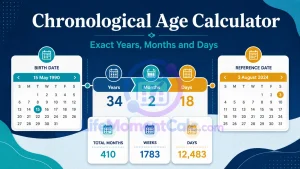
The result therefore includes calendar years, months, and days as a separate reference. Use the Chronological Age Calculator when anniversary boundaries or exact calendar components are more important.
Choosing the Right Precision
Two decimal places are suitable for general summaries. Three or four may help with research records or comparisons where smaller differences matter. Six decimal places display much finer subdivisions but do not make uncertain input dates more accurate.
One decimal year under the 365.2425-day convention represents approximately 36.52425 days. Therefore, a change of 0.01 year is roughly 3.65 days, while 0.001 year is roughly 8.77 hours.
Because the input contains dates rather than times, extremely fine displayed precision should be interpreted carefully.
Reading the Result Panel
The headline presents decimal years at the chosen precision. Supporting rows report elapsed days, calendar age, and the year-length convention used.
These fields make the result auditable. If another calculation differs, compare the elapsed-day count and denominator before assuming either result is wrong.
A one-day discrepancy may arise from inclusive counting, time-zone handling, or a tool that treats the end date as a completed additional day.
Useful Applications and Limitations
Decimal age can support research datasets, statistical analysis, demographic summaries, or records that require one continuous numeric variable.
It should not replace official age rules when a policy requires completed birthdays, calendar months, or a particular assessment convention. Medical, academic, and legal contexts may specify their own method.
The result also does not account for uncertainty in historical records. If the birth date is approximate, additional decimal places only create false precision.
Frequently Asked Questions
Which year-length convention should be used?
Use the convention required by the intended purpose. When none is specified, 365.2425 provides a transparent mean-Gregorian default.
Why can decimal age differ from years plus months divided by 12?
Completed calendar months do not all contain the same number of days.
Are leap years counted?
Yes. Elapsed days reflect the actual Gregorian dates. The selected denominator controls only conversion into decimal years.
Can the result include today’s partial day?
No. This date-based tool uses complete civil-date boundaries, not time-of-day instants.