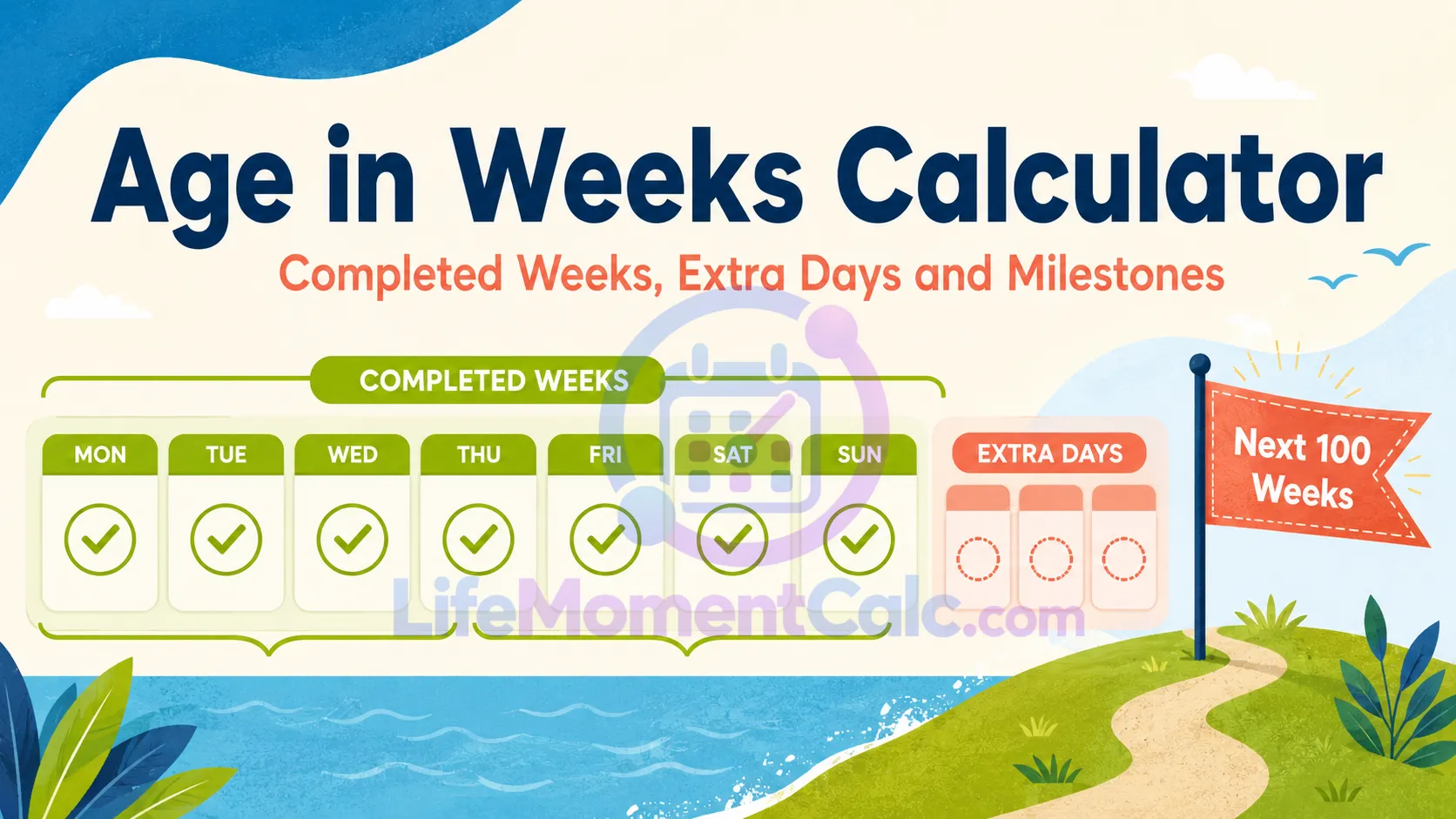
The Age in Weeks Calculator measures the exact number of civil days between a birth date and reference date, then groups that interval into seven-day weeks. It reports completed weeks, extra days, and decimal weeks without estimating from age in years.
The result also identifies the next multiple-of-100-week milestone and its calendar date. This can be useful for personal curiosity, child-age records, project timelines, or marking an unusual age milestone.
Find completed weeks, extra days, decimal weeks, and your next 100-week milestone. The tool divides the exact elapsed civil-day count by seven, showing completed weeks, extra days, and decimal weeks. It also finds the date of your next 100-week milestone. Weeks have a fixed seven days, while years and months do not. That is why the full-week result is based on elapsed days rather than multiplying a rounded age in years.Age in Weeks Calculator
Age in weeks
Exact full weeks
Calendar note
Why Weeks Are Simpler Than Calendar Months
A week always contains seven days. Calendar months vary from 28 to 31 days, and calendar years contain 365 or 366.
Because of that consistency, the reliable way to calculate age in weeks is to count total elapsed days first and divide by seven. Multiplying a rounded age in years by 52 is only an approximation because a year contains slightly more than 52 weeks.
For example, 365 days equal 52 weeks and 1 day, while 366 days equal 52 weeks and 2 days.
Formulas Used for Age in Weeks
Let D be the exact number of elapsed civil days.
Completed weeks = floor(D ÷ 7)
Extra days = D mod 7
Decimal weeks = D ÷ 7
Suppose 1,000 days have elapsed:
Completed weeks = floor(1,000 ÷ 7) = 142
Extra days = 1,000 mod 7 = 6
Decimal weeks = 1,000 ÷ 7 ≈ 142.857
The primary result would therefore be 142 weeks and 6 days.
Dates are normalized as civil dates, so the calculation is not altered by daylight-saving clock changes. Time of birth is not included.
Next 100-Week Milestone Formula
The tool divides the current decimal week count by 100 and rounds upward to find the next multiple of 100.
Next milestone = ceiling(Current weeks ÷ 100) × 100
If the current value is already exactly a multiple of 100, the next milestone advances by another 100 rather than returning today’s completed milestone.
The milestone date is:
Milestone date = Birth date + Next milestone × 7 days
At 142.857 weeks, the next milestone is 200 weeks. Its date is the birth date plus 1,400 days.
Understanding the Output
The headline displays completed weeks and remaining days. Supporting details show decimal weeks, total elapsed days, and the next 100-week milestone.
Completed weeks answer how many entire seven-day periods have passed. Decimal weeks preserve the fractional portion. The milestone field combines a target week number with its corresponding date.
Do not add the completed and decimal values together; they are alternative formats for the same interval.
When Age in Weeks Is Useful
Weeks can be convenient for relatively short periods and for comparing intervals that need consistent units. Parents sometimes track early ages in weeks, while researchers or project planners may prefer exact seven-day blocks.
However, developmental, clinical, and eligibility decisions should follow the terminology and thresholds used by the relevant professional guidance. A numerical week count does not assess development or health.
For a calendar-based alternative, the Age in Months Calculator separates completed monthly anniversaries from approximate decimal months.
Differences Between Week Calculators
Results may differ when another calculator:
- Includes both starting and ending dates
- Uses a birth time and current time
- Converts years to weeks using 52
- Applies a particular time zone
- Rounds decimal weeks before calculating completed weeks
This tool measures the difference between civil dates and treats the birth date as the starting boundary, not a completed first day.
Leap Years and Weekday Changes
Leap days are automatically present in the elapsed-day count. They do not require a special anniversary rule because the calculation does not add calendar years.
A birthday’s weekday normally advances by one weekday each common year and two across a leap-day boundary. This affects calendar labels but not the seven-day grouping formula.
Frequently Asked Questions
Is one year exactly 52 weeks?
No. A 365-day year is 52 weeks and 1 day; a leap year is 52 weeks and 2 days.
Does the result include partial weeks?
Yes. Extra days and decimal weeks represent the unfinished portion.
Can weeks be calculated on a historical date?
Yes. Enter that date as the reference date.
Why is the next milestone another 100 weeks at exactly 200 weeks old?
The tool intentionally identifies the next future milestone, which would be 300 weeks.