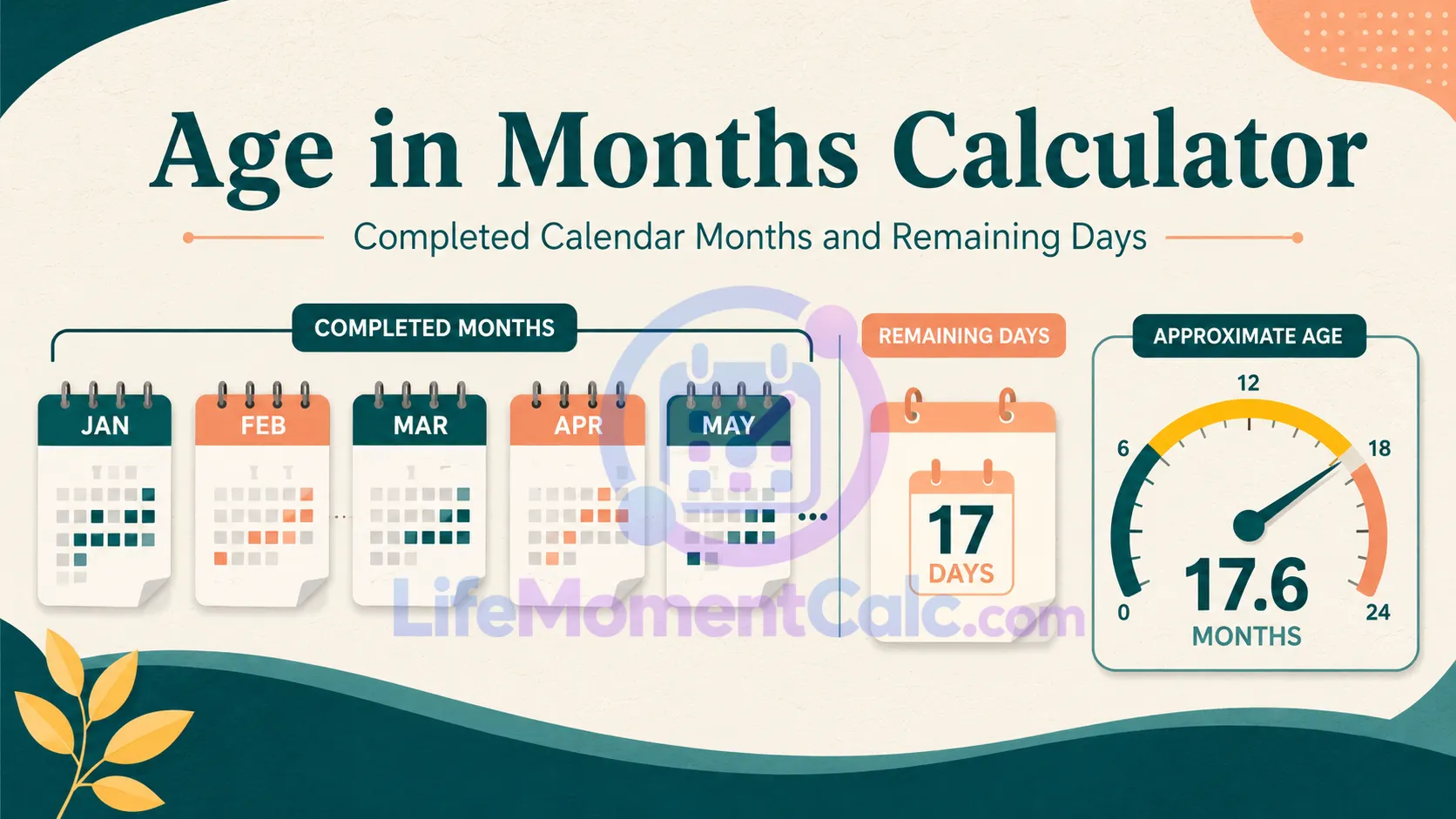
Months are not fixed-duration units. The Age in Months Calculator therefore provides two distinct measurements: completed calendar months based on monthly anniversaries and approximate decimal months based on an average Gregorian month.
The main result reports whole calendar months plus remaining days. Additional details include total elapsed days, approximate decimal months, and the date of the next monthly anniversary.
Calculate completed calendar months, remaining days, and approximate decimal months without treating every month as equal. Completed calendar months count monthly anniversaries and then show remaining days. Approximate decimal months divide elapsed days by one-twelfth of the mean Gregorian year. Both are shown because they answer different questions. For medical, developmental, or eligibility decisions, follow the applicable professional guidance. This calculator supplies date arithmetic only and does not interpret development, dosage, or health status.Age in Months Calculator
Age in months
Completed versus approximate months
Clinical and developmental use
Completed Months Follow Calendar Anniversaries
A completed calendar month occurs when the corresponding day-of-month anniversary has been reached. The calculator first counts complete years, then complete calendar months, and finally the remaining days.
If the original day does not exist in a shorter month, the date is adjusted to that month’s last valid day. This makes the sequence usable for dates such as January 31 without inventing February 31.
The result is not produced by dividing days by 30 because doing so would treat unequal calendar months as identical.
Formulas Used for the Two Month Results
Completed Calendar Months
The calendar-age calculation determines completed years and months:
Completed calendar months = Completed years × 12 + Additional completed months
Remaining days are counted after the latest completed monthly anchor.
Approximate Decimal Months
The mean month length is one-twelfth of the mean Gregorian year:
Mean Gregorian month = 365.2425 ÷ 12
Mean Gregorian month ≈ 30.436875 days
The approximate decimal result is:
Decimal months = Total elapsed days ÷ 30.436875
Suppose 1,000 days have elapsed:
1,000 ÷ 30.436875 ≈ 32.854 months
That figure is an average-duration conversion, not a count of completed monthly anniversaries.
Why the Results May Not Match
Consider a period containing several 31-day months. The average-based decimal result distributes those days evenly across 30.436875-day units, while the calendar result waits for actual anniversaries.
A displayed value of 18 completed months and 10 days therefore cannot always be recreated by converting 10 days into a fraction of an average month. The two outputs use intentionally different definitions.
This distinction matters when a policy specifies “completed months of age.” In that case, the calendar result may be more relevant than a decimal approximation, subject to the policy’s own rules.
What the Result Panel Contains
The headline gives completed calendar months and remaining days. The detail area includes:
- Approximate decimal months
- Total elapsed civil days
- Next monthly anniversary
The next monthly anniversary adds one to the completed-month count and applies it to the original birth date. It identifies the next calendar boundary, not the date on which the decimal value reaches the next whole number.
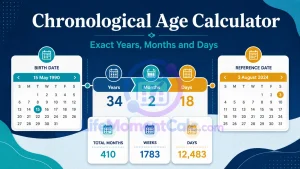
The Chronological Age Calculator provides the same interval in years, months, and days, while the Age in Weeks Calculator uses fixed seven-day groups.
Month-End Birth Dates
Dates near the end of a month require careful handling. When an anniversary month has fewer days, the tool uses its final valid date.
For example, a monthly anniversary originating on the 31st may fall on the 30th or on the last day of February. Subsequent calculations continue from the original date-based sequence rather than permanently replacing the birth day.
Organizations may prescribe a different convention for a particular administrative purpose. Verify their rules when eligibility depends on an exact boundary.
Clinical and Developmental Limitations
Age in months is often used when discussing early childhood, but a date calculation cannot evaluate growth, development, medical status, or appropriate dosage.
Healthcare and developmental professionals may use corrected age, gestational information, completed months, or other procedures that this tool does not infer. Follow the applicable guidance rather than relying on the numerical result alone.
Improving Interpretation
Use completed months when asking how many monthly anniversaries have occurred. Use decimal months when a continuous approximate unit is needed for analysis.
Always state which measurement you are reporting. Writing “18.4 months” without explaining that it uses an average month may invite incorrect comparison with an anniversary-based age.
Frequently Asked Questions
Is every month treated as 30 days?
No. Completed months use real calendar boundaries. Only the approximate result uses a mean month length.
Why does February affect the remaining days?
February has fewer days, so month anchors and elapsed-day intervals differ from longer months.
Are leap days included?
Yes. They are part of the actual civil-day interval.
Does the tool provide corrected age for premature birth?
No. It supplies date arithmetic only.