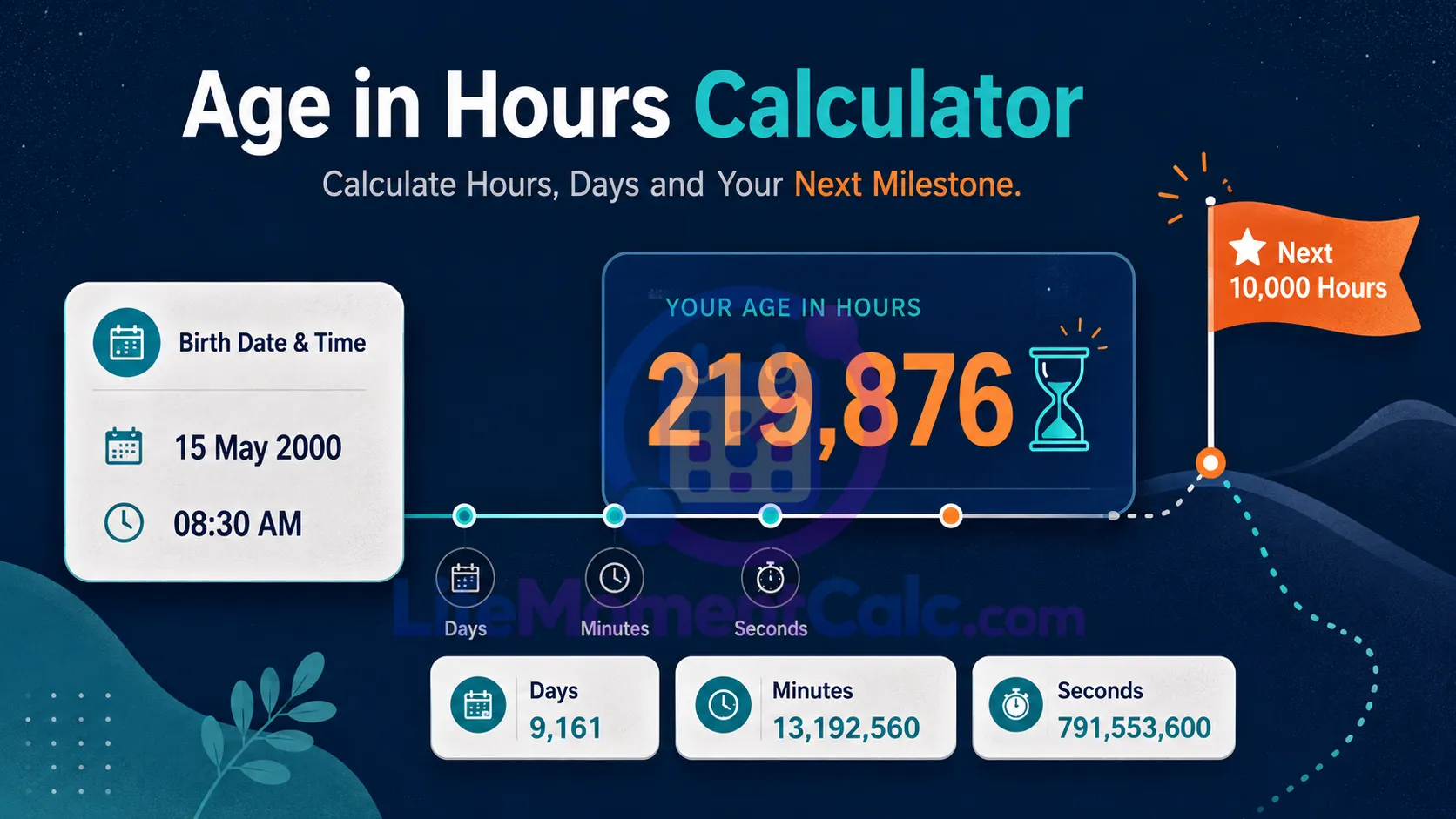
The Age in Hours Calculator converts the actual elapsed interval between two date-time values into completed hours. It also reports completed days, total minutes, total seconds, and the next 10,000-hour milestone.
Unlike a shortcut that multiplies a rounded age in years by 8,760, this tool uses the millisecond difference between the entered instants. That preserves sub-day information and accounts for the actual date-time interval interpreted by the browser.
Measure elapsed age in hours and related units, including the next major hour milestone. The tool converts the date-time difference directly into hours rather than multiplying a rounded age in years. Full hours, partial-hour minutes, days, and the next 10,000-hour milestone are shown. A date without a known birth time cannot establish an exact sub-day age. Use the unknown-time option to make that limitation visible in the result instead of presenting false precision.Age in Hours Calculator
Age in hours
Hours from actual elapsed time
Exact or estimated
What to Enter
Provide the birth date and time. Enter a reference date and time or leave that field blank to use the current moment.
When the exact birth time is unavailable, select the unknown-time option. The calculation will use the entered midnight time but label the result as estimated.
The reference instant must occur after birth. Date-only values are not sufficient for exact lifetime hours because even a twelve-hour uncertainty creates a twelve-hour difference.
Formula Used for Age in Hours
Let B be the birth instant and R be the reference instant, both represented in milliseconds.
Elapsed milliseconds = R − B
Total hours = Elapsed milliseconds ÷ 3,600,000
Completed hours = floor(Total hours)
Related conversions are:
Total minutes = Elapsed milliseconds ÷ 60,000
Total seconds = Elapsed milliseconds ÷ 1,000
Completed days = floor(Total hours ÷ 24)
If 180,000,000 milliseconds have elapsed:
180,000,000 ÷ 3,600,000 = 50 hours
That equals two completed 24-hour days with two hours remaining.
The tool calculates from elapsed time rather than assuming that every civil day had exactly 24 local clock hours.
Finding the Next 10,000-Hour Milestone
The next target is calculated from the current decimal-hour total:
Next milestone = ceiling(Current hours ÷ 10,000) × 10,000
If the current total is already exactly 10,000, 20,000, or another multiple, the target advances by another 10,000 hours.
Hours remaining = Next milestone − Current hours
The remaining duration is added to the reference instant to produce the milestone’s local date and time.
A person at 87,650 hours would therefore receive a target of 90,000 hours, with 2,350 hours remaining.
Why Daylight-Saving Changes Matter
Elapsed hours measure actual time between instants. A local date interval containing a daylight-saving transition can include a 23-hour or 25-hour local day.
This is one reason the result may not equal calendar days multiplied by 24. The browser’s time-zone implementation determines how local date-times are interpreted.
Historical time-zone changes can be especially difficult when the birthplace and current location differ. For exact professional timing, use verified time-zone-aware records rather than treating a local form as authoritative.
Reading the Output Correctly
The headline displays completed hours. Supporting rows report completed days, total minutes, total seconds, and the next milestone.
Completed days do not include the partial day represented by leftover hours. Total minutes and seconds describe the complete duration at smaller units.
These fields should not be added. For a calendar-age result that ignores time of day, use the Chronological Age Calculator.
Hours Versus Calendar Age
Calendar age changes on anniversary dates. Elapsed hours progress continuously. A person may have completed a calendar birthday while still being several hours short of the exact elapsed-hour anniversary of their birth instant.
Neither representation is universally better. Calendar age is appropriate for most everyday age questions, while hours are useful for time-based milestones and precise duration comparisons.
Limitations and Responsible Use
The Age in Hours Calculator is intended for informational time calculation. It does not establish legal age, medical eligibility, work duration, billing periods, or official deadlines.
Selecting “birth time unknown” communicates uncertainty but does not reduce it. Midnight is only a neutral starting estimate.
Frequently Asked Questions
Is one day always 24 elapsed hours?
An elapsed day is defined as 24 hours, but a local civil day around a clock change may contain 23 or 25 hours.
Why are partial-hour minutes not in the headline?
The headline reports completed hours. Related units provide additional detail.
Can the next milestone fall at a different local clock time?
Yes. Time-zone offset changes can affect the displayed local time.
Does leaving the reference field blank use today at midnight?
No. It uses the current moment.