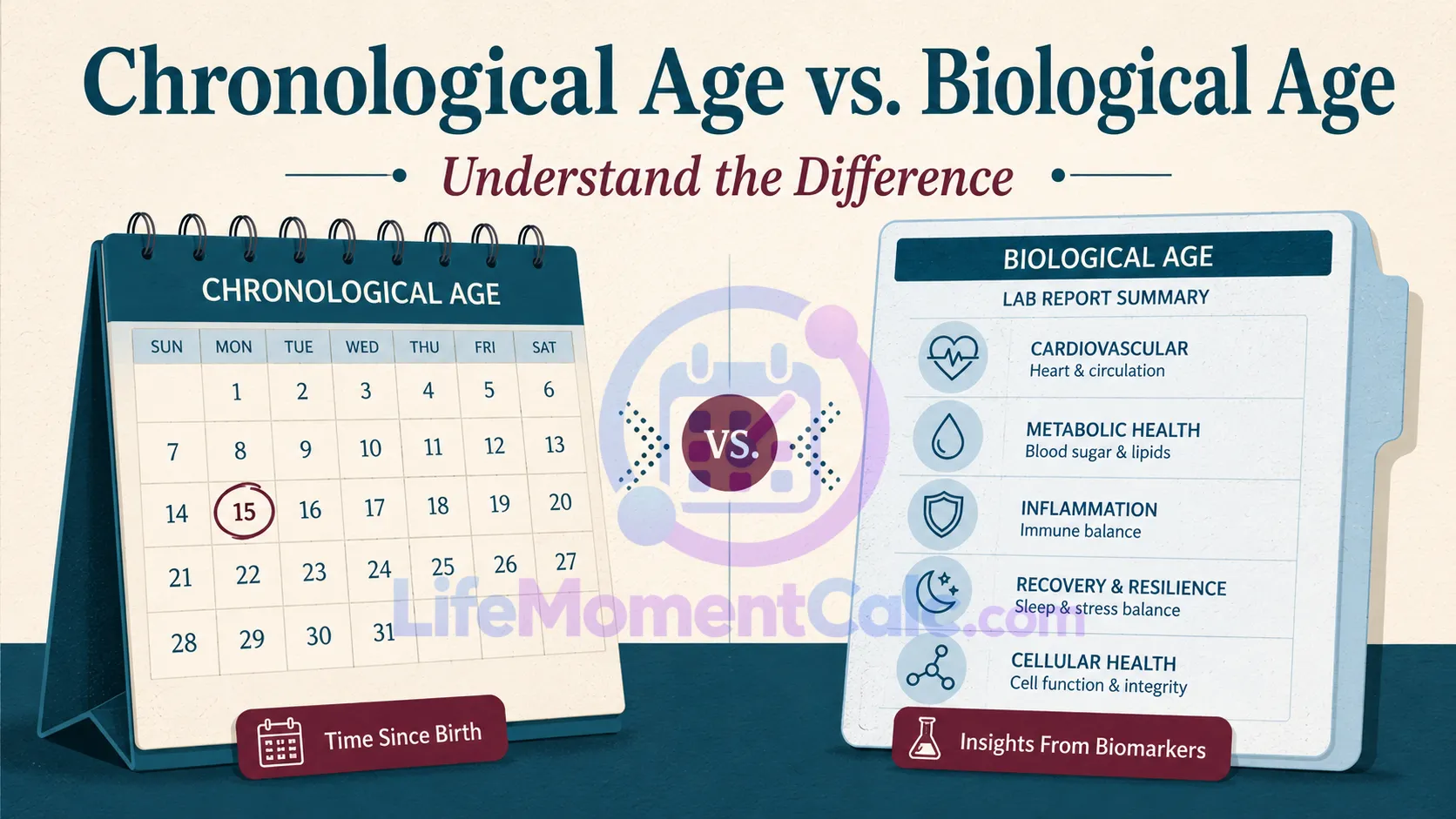
Chronological age and biological age are not interchangeable measurements. Chronological age is the exact calendar interval since birth. Biological age is a model-derived estimate based on specified biological or functional measurements.
The Chronological Age vs. Biological Age tool calculates calendar age and explains several biological-age measurement categories. It does not create a biological-age estimate from a lifestyle questionnaire. An optional independent laboratory result may be entered for numerical comparison.
Calculate chronological age, explore validated measurement categories, and compare an optional independent lab result. Chronological age is exact date arithmetic. Biological age is a model-derived estimate requiring specific biomarkers and a validated algorithm. A lifestyle quiz cannot reproduce an epigenetic or blood-based clock, so this tool explains measurement methods and compares only a value supplied by an independent report. Biological-age tests can differ by method, population, laboratory, and intended outcome. Results are not a diagnosis and should be discussed with an appropriately qualified healthcare professional.Chronological Age vs. Biological Age
Age comparison
Why this tool does not guess biological age
Medical limitation
What Chronological Age Measures
Chronological age answers how much calendar time has passed between birth and a comparison date. The calculation counts completed years, completed months, and remaining days.
The tool also computes decimal chronological age using the mean Gregorian year:
Decimal chronological age = Total elapsed days ÷ 365.2425
This decimal value provides a consistent basis for comparing an independently reported biological-age number.
Chronological age is reproducible from dates. It does not measure health, function, appearance, or rate of aging.
What Biological Age May Represent
“Biological age” describes estimates produced by models intended to reflect aspects of biological aging. Different methods measure different signals and may not agree.
The tool explains four broad categories:
DNA Methylation or Epigenetic Clocks
These models analyze methylation patterns at selected DNA locations. Different clocks use different locations, training datasets, and target outcomes.
Phenotypic Blood-Biomarker Models
These approaches combine laboratory measurements through a published algorithm. The selected biomarkers and model coefficients determine the result.
Telomere Length
Telomeres are protective chromosome-end structures that can change with cell division and other processes. Telomere length and epigenetic clocks are distinct markers rather than interchangeable tests.
Functional or Fitness Measures
Some assessments use physical or physiological performance. Their meaning depends on the protocol, population, and comparison model.
A value from one method should not automatically be compared as if it were identical to a value from another.
Formula Used for the Optional Comparison
When a laboratory-reported value is entered, the tool calculates:
Age difference = Reported biological age − Decimal chronological age
A positive result means the supplied biological-age number is numerically older than decimal chronological age.
A negative result means it is numerically younger. Zero means the two displayed values are equal at the calculator’s precision.
For example:
Reported age 48.0 − Decimal chronological age 45.5 = +2.5 years
This is a numerical comparison only. The tool did not calculate, verify, or clinically interpret the reported value.
Why the Tool Does Not Use a Lifestyle Quiz
A browser questionnaire cannot reproduce laboratory analysis of DNA methylation, blood biomarkers, telomeres, or a validated functional protocol.
Sleep, exercise, diet, smoking, stress, and medical history may be relevant to health, but assigning arbitrary points to them does not create a validated biological-age test.
Avoiding an invented estimate is more responsible than returning an impressive-looking number without a defensible model.
The Chronological Age Calculator can provide a more detailed calendar and total-day breakdown without entering biological information.
How to Interpret an Independent Result
Review the report’s method, sample type, reference population, uncertainty, and intended use. Two companies or laboratories may produce different values from the same person because their models differ.
A biological-age result is not a diagnosis. A numerically older result does not identify a disease, and a younger result does not guarantee health or longevity.
Discuss medical concerns with an appropriately qualified healthcare professional who can interpret the result alongside established clinical information.
Privacy Considerations
The comparison requires only the reported number, not the laboratory name, genetic data, biomarker values, or medical history. Avoid entering or publishing unnecessary health information.
The calculation occurs locally, but screenshots and copied results may become public if shared elsewhere.
Frequently Asked Questions
Can the tool calculate biological age?
No. It explains methods and compares only an independently supplied value.
Which biological-age method is best?
Methods measure different signals and have different evidence, populations, and purposes. There is no context-free answer.
Does a positive age difference indicate poor health?
No. It is a numerical difference, not a diagnosis or complete health assessment.
Can biological age change?
Some measures can change between tests, but interpretation requires understanding the method, measurement variability, and clinical context.