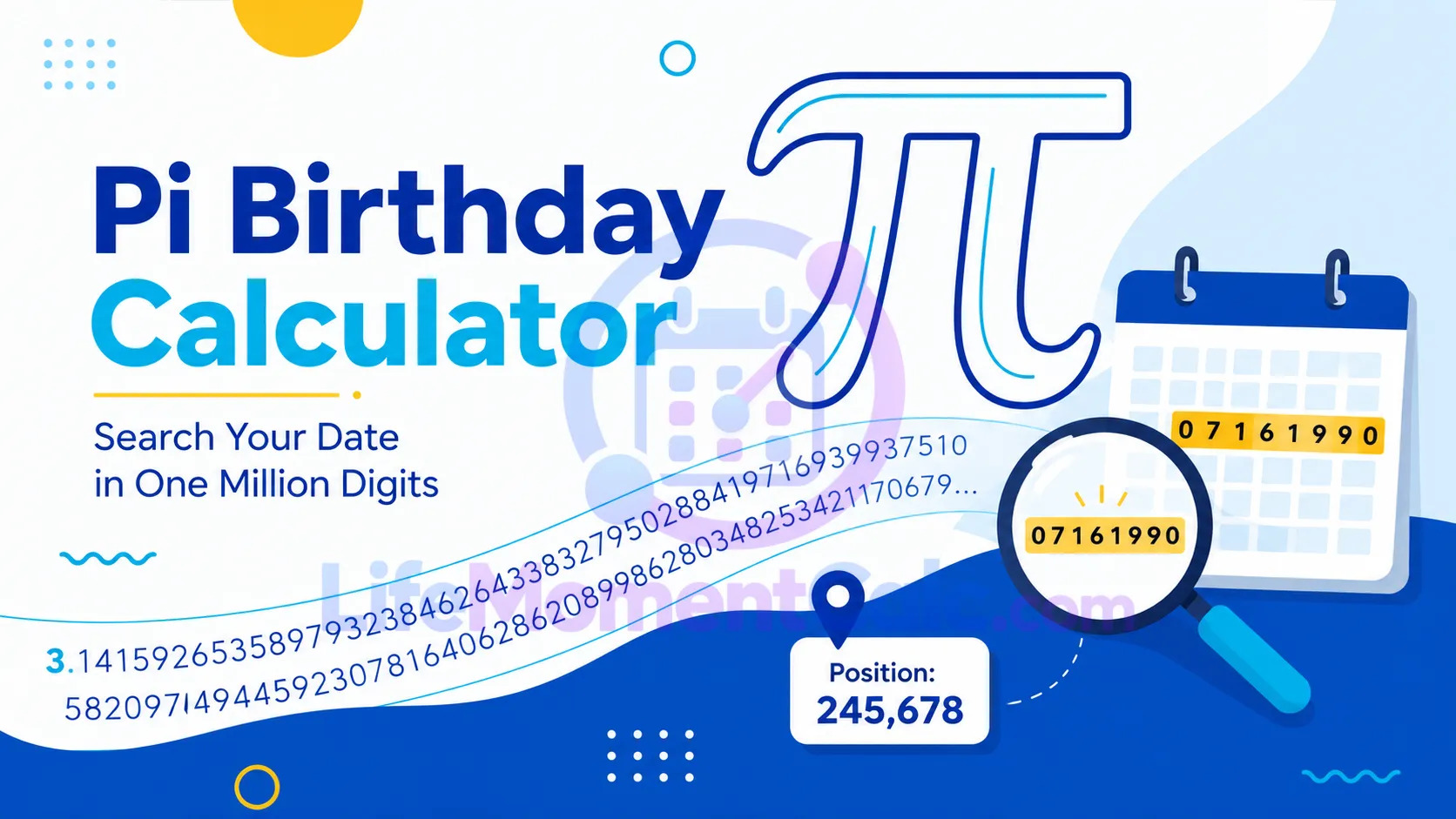
Can your birthday be found inside the decimal digits of π? The Pi Birthday Calculator converts a selected date into common numeric formats and searches for each exact sequence within the first one million digits after the decimal point.
The tool does more than announce a match. It identifies the format, displays the padded numeric sequence, reports its first position using one based counting, and provides surrounding digits for verification. When no match appears, it explains exactly what that result means.
Search several unambiguous numeric date formats in the first one million verified digits after π’s decimal point. The tool searches the first one million digits after π’s decimal point, locally in the browser. It reports the first position for each selected padded date format and shows surrounding verified digits. Position 1 is the first digit after the decimal point. A missing sequence means only that the chosen format does not appear in this one-million-digit window. It does not mean the sequence never appears later. Although π is known to be irrational, it has not been proved normal, so the tool does not claim that every finite sequence must occur.Pi Birthday Calculator
Birthday in π
What is searched
Interpreting no match
Select a Birthday and Search Format
Enter a valid date and choose whether to search all formats or one format family. The available families are month day year, day month year, and year month day.
Selecting all formats checks these six sequences:
- MMDDYYYY
- MMDDYY
- DDMMYYYY
- DDMMYY
- YYYYMMDD
- YYMMDD
Months and days are padded to two digits. For example, March becomes 03, not 3. Two digit years use the final two digits of the year.
Select Search one million digits to see which formats appear.
Exact Search Method Used by the Pi Birthday Calculator
The plugin contains a verified local string of exactly 1,000,000 digits after π’s decimal point. The initial digits are checked against the known prefix beginning 141592653589793238462643383279.
For every selected format, the calculator creates one uninterrupted sequence with no slashes, dashes, or spaces. It then performs an exact character search:
Match index = first zero based index of the date sequence
When a match exists, the displayed location is converted to a one based position:
Displayed position = match index + 1
Therefore, position 1 means the first digit after the decimal point, which is the 1 in 3.14159…. Only the first occurrence of each sequence is reported.
The context display includes up to 12 digits before and after the matching string. Its starting position is adjusted when a match appears near the beginning of the dataset.
Why One Birthday Produces Several Searches
A date written as 04/07/1990 is ambiguous. It could mean April 7 or 4 July depending on regional convention. The calculator avoids silently choosing one interpretation by labeling every sequence.
Full year formats contain eight digits and are more specific. Two digit year formats contain six digits and are shorter, making them more likely to appear within a fixed search window. However, a shorter sequence may also represent many unrelated dates.
The displayed format label is therefore essential. Share both the sequence and its label when discussing a result.
Understanding “Not Found”
A no match result has a narrow meaning: that exact sequence did not occur within the first one million checked decimal digits.
It does not show that the sequence never occurs later. The search stops at a defined boundary, and π has infinitely many nonrepeating decimal digits. Although π is irrational, irrationality alone does not prove that every possible finite sequence must appear. The stronger property associated with evenly distributed digit patterns is called normality, and π has not been proved normal.
For that reason, the calculator avoids saying that every birthday is guaranteed to occur somewhere in π.
Position and Context Details
Suppose a sequence begins at the 25th checked digit. The calculator reports position 25 because its convention starts counting immediately after the decimal point.
The surrounding context is useful for validating the match and distinguishing it from an isolated claim. The date sequence remains an ordinary run of digits; π does not label it as a birthday or attach meaning to its location.
If you enjoy numerical birthday comparisons, the Birthday Rarity Calculator explores an entirely different question using historical daily birth counts.
Privacy and Performance
The date and digit search remain in the browser. The tool does not send the birthday to an external π search service.
The one million digit data asset is loaded only on a page containing the Pi Birthday Calculator shortcode. This prevents unrelated pages from downloading the larger dataset unnecessarily.
Search time can vary slightly by browser and device, but modern browsers can generally search this one million character local string quickly.
Useful and Misleading Interpretations
The calculator works well for number themed birthday cards, classroom demonstrations, math club activities, social posts, or personal curiosity. A verified context string can make the result more interesting to share.
A match is not evidence that π predicted the birthday or contains a hidden personal message. Any meaning attached to the position is creative interpretation rather than mathematics.
Likewise, finding a two digit year format is not equivalent to finding the full eight digit date. State which version matched.
Pi Birthday Questions
Does the tool search the digit 3 before the decimal?
No. It searches only the first one million digits after the decimal point.
Are leading zeros included?
Yes. Month and day fields always contain two digits, which keeps every format structurally consistent.
Why did a six digit version match but an eight digit version did not?
A shorter string has more opportunities to occur in a fixed digit window. The two sequences are separate searches.
Can the same sequence occur more than once?
Yes, but the tool reports only its first position in the one million digit dataset.