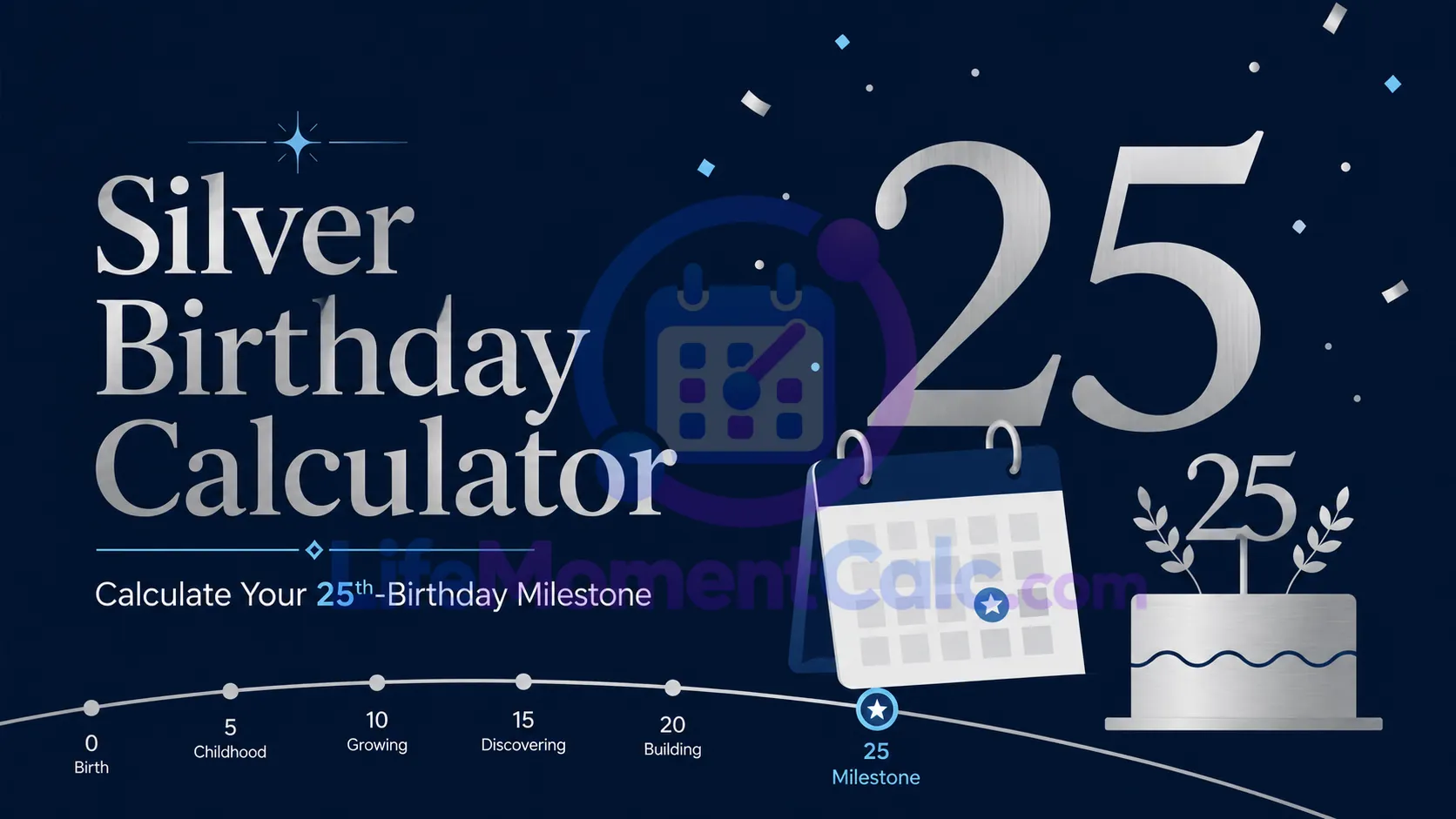
A Silver Birthday Calculator finds the date on which a person turns 25. The name borrows the familiar silver association of a 25th anniversary, but a silver birthday is an informal celebration label rather than an official calendar category.
The underlying date is precise even though the label is cultural. By entering a birth date and calculation date, you can see the milestone’s weekday, whether it is approaching or has passed, and your exact chronological age on the selected date.
Find the date of a 25th birthday, weekday, countdown or time elapsed, and adjacent milestone dates. “Silver birthday” is an informal name commonly used for the 25th birthday, borrowing the silver association from a 25th anniversary. The tool therefore adds 25 calendar years to the birth date and reports whether that milestone is upcoming, today, or past. The label has no official or universal status. The exact date calculation is factual; celebration meaning and traditions are personal.Silver Birthday Calculator
Milestone details
Definition used
Planning context
What “Silver Birthday” Means in This Calculator
Birthday labels can vary across websites, families, and social trends. This tool uses one clearly stated definition:
A silver birthday is the 25th birthday.
It does not use a reversed-number rule or attempt to merge silver birthdays with golden, diamond, or platinum milestones. Showing the definition alongside the result helps prevent an attractive label from being mistaken for a universal tradition.
Formula Used by the Silver Birthday Calculator
The milestone date is calculated with calendar-year arithmetic:
Silver birthday date = date of birth + 25 calendar years
The calculator preserves the original month and day whenever that date exists in the target year.
For a February 29 birth whose 25th-birthday year is not a leap year, you must choose one of two conventions:
- Use February 28
- Use March 1
The status is then calculated as a signed civil-day difference:
Signed days = silver birthday date − calculation date
A positive result means the milestone is upcoming, zero means it is today, and a negative result means it has passed.
Information Included in the Result
The calculator does more than display a year. Its result includes the full milestone date and the weekday on which it falls.
You will also see:
- Milestone age: turning 25
- Days remaining or days elapsed
- Exact current age in years, months, and days
- The rule used to define the silver birthday
- Total civil days lived as of the calculation date
These details support planning and also make it easier to verify that the entered dates were interpreted correctly.
Planning for a Future 25th Birthday
If the silver birthday is still ahead, the signed day count gives you a practical planning window. It can help with venue reservations, travel arrangements, photography, a memory project, or a simple personal reminder.
The weekday is particularly useful. A milestone that falls on a weekday may be celebrated on the nearest weekend, but the calculator retains the actual anniversary date so that celebration plans do not replace the factual result.
For someone who has already turned 25, the tool reports the original date and elapsed time. It does not create a second silver birthday. If you want a milestone based on the day of the birth month instead, use the Golden Birthday Calculator.
Leap-Day Births Need a Stated Convention
A person born on February 29 reaches the age of 25 after 25 calendar years, but the corresponding non-leap-year observance date is not handled identically everywhere.
The calculator therefore asks for a policy instead of selecting one invisibly. This setting controls the milestone date and chronological-age breakdown produced by the tool.
The option is a calculation convention, not a legal ruling. Where a date affects an official deadline, benefit, contract, or eligibility decision, the governing authority’s rule takes priority.
What the Calculator Does Not Claim
Turning 25 may be personally significant, but the term “silver birthday” has no universal legal, religious, or administrative meaning. The tool does not determine maturity, financial status, insurance rules, or any other age-dependent entitlement.
Its total-days-lived result is based on civil calendar dates. It does not include a birth time, time zone, or partial day and should not be interpreted as an exact lifetime duration in hours.
A Reliable Result for an Informal Milestone
The Silver Birthday Calculator separates the dependable part of the result from the optional symbolism. Adding 25 calendar years produces the milestone date. The weekday, current age, and day difference are factual consequences of the entered dates. Calling the occasion “silver” is a celebration choice.
That distinction gives the page real value. The result provides more than a decorative birthday label: it includes a transparent date calculation, an explicit leap-day setting, and information that remains useful whether the milestone is in the future, present, or past.