Milestone birthday names are popular, but their definitions are not always consistent. The Golden Platinum and Diamond Birthday Calculator calculates three informal conventions on one timeline and clearly displays the rule behind each date.
Enter a date of birth, choose a diamond birthday definition, and select how a February 29 birthday should be observed in nonleap years. The result shows each milestone’s target age, calendar date, status relative to today, and applied rule.
Compare three informal milestone conventions on one timeline and make the ambiguous diamond rule explicit. Golden means age equals the day of the month. Platinum uses the final two digits of the birth year, with a year ending in 00 mapped to age 100. “Diamond birthday” has no single definition, so the form requires a choice: age 60, age 75, or the final-two-digits rule. These names are social traditions rather than official age categories. The date arithmetic is exact under the selected rule; the label’s meaning and appropriate celebration remain personal and regional.Golden, Platinum & Diamond Birthday Tool
Milestone birthday timeline
Rules compared
Informal labels
Three Celebrations on One Clear Timeline
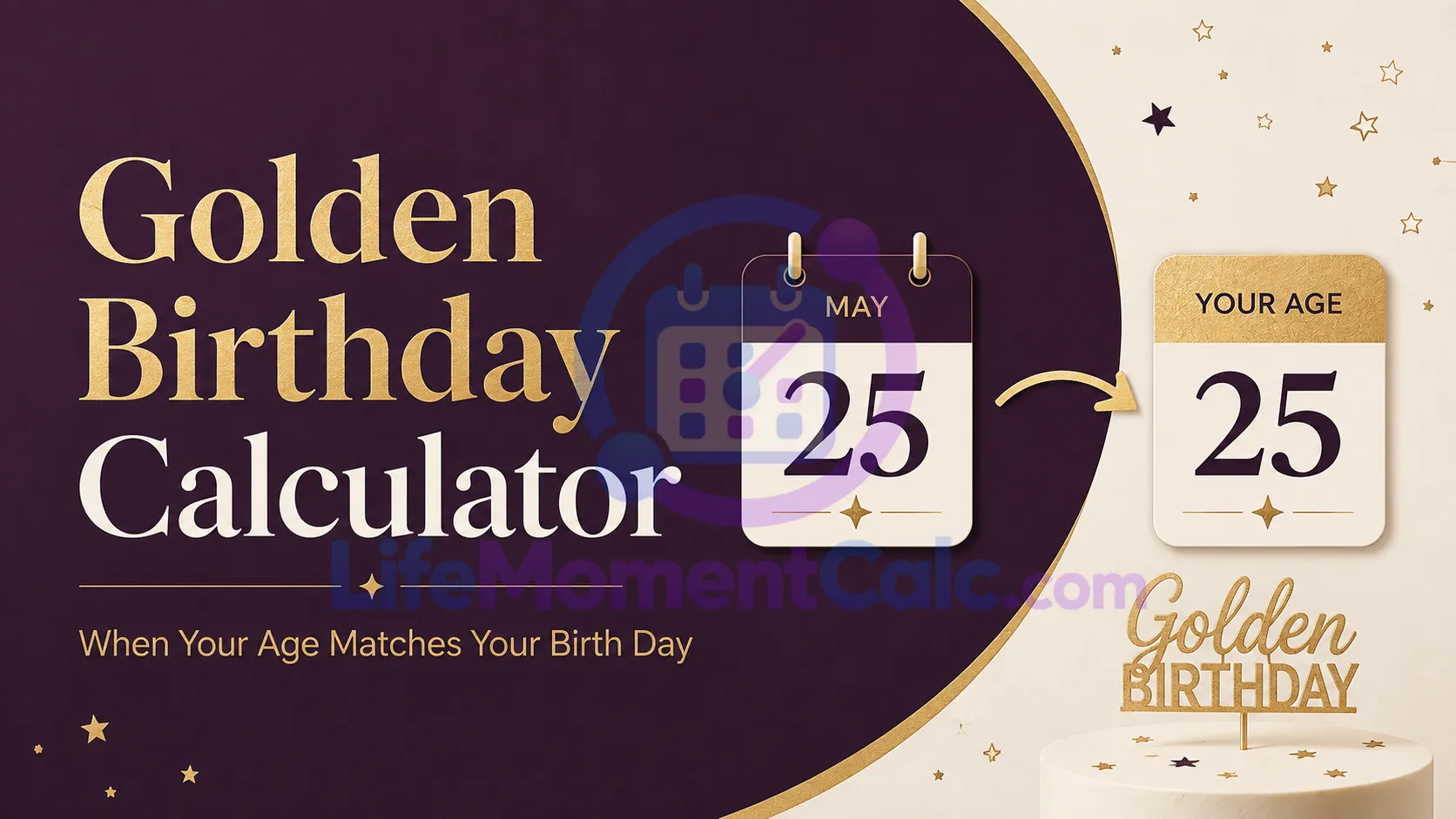
A golden birthday occurs when a person’s age matches the day of the month on which they were born. Someone born on the 24th has a golden birthday when turning 24.
The plugin defines a platinum birthday as the age matching the final two digits of the birth year. A person born in 1992 therefore has a platinum birthday at age 92.
“Diamond birthday” has competing informal meanings, so the calculator does not silently select one. Choose the 60th birthday, 75th birthday, or final two birth year digits convention before calculating.
Formulas Used for Each Milestone Birthday
Let D represent the birth day and Y represent the four digit birth year.
Golden Birthday
Golden age = D
Golden date = birth date advanced by D years
Platinum Birthday
Platinum age = Y mod 100
If the birth year ends in 00, the result would normally be zero. Because age zero is the day of birth rather than an ordinal birthday, the plugin maps it to age 100:
If Y mod 100 = 0, platinum age = 100
Diamond Birthday
The target depends on the selected convention:
Diamond age = 60, or
Diamond age = 75, or
Diamond age = platinum age
For every milestone:
Milestone year = birth year + target age
The original birth month and day are retained unless a February 29 observance adjustment is required.
The status is calculated from the number of calendar days between today and the milestone date. It is displayed as today, days from today, or days ago.
Why the Diamond Rule Must Be Selected
Unlike a golden birthday, “diamond birthday” does not have one widely agreed formula. Some people use it for turning 60, influenced by diamond anniversary language. Others use 75, while some date based birthday traditions apply the final two digits of the birth year.
Showing a date without naming the convention would create false certainty. This tool makes the ambiguity part of the interface so the relevant meaning can be chosen for a family, community, or celebration plan.
February 29 Birthday Handling
A person born on February 29 does not have that calendar date in most years. The form therefore offers two observance policies:
- Use February 28 in a nonleap milestone year.
- Use March 1 in a nonleap milestone year.
This selection controls the displayed celebration date; it does not make a legal determination. Laws and official age rules for leap day birthdays vary by jurisdiction and purpose.
Planning with the Results
The combined table makes it easy to see whether a milestone has passed or is still ahead. It can support party planning, keepsake design, family timelines, greeting card ideas, or editorial content about unusual birthday traditions.
A milestone occurring many years away can still be saved as a long term family note. If one occurred in childhood or before the name became familiar, some people choose a belated themed celebration. These labels are social traditions, so the celebration does not need to follow a formal rule.
The Birthday Wishes Generator can create a message for the selected milestone. To compare the statistical frequency of the underlying month and day, use the Birthday Rarity Calculator.
Important Interpretation Notes
The date arithmetic is exact under the selected rules, but the labels themselves are informal. They are not official age categories and do not affect legal rights, eligibility, retirement, health, or identity.
A platinum result based on the birth year can occur very late in life. It can also occur at a relatively young age for someone born early in a century. That variation is a consequence of the selected formula, not an error.
Milestone Birthday FAQs
Can a golden birthday happen before someone learns about it?
Yes. People born on a low numbered day may have their golden birthday in childhood. A later golden themed celebration is a personal choice.
What happens for someone born in 2000?
The final two digits are 00, so the plugin maps the platinum age to 100 instead of age zero.
Which diamond birthday definition is correct?
There is no universal answer. Select the convention used by your family, audience, or event and state it when sharing the result.
Are leap day observance rules legal rules?
No. The February 28 or March 1 choice controls this informal timeline only. Consult the relevant authority for an official legal age question.